The complaint usually arrives dressed as a sigh: it worked for years, and then it didn’t. Modern heating systems sit at the centre of daily life - in flats, terraces, new-builds - yet their complexity means a tiny fault can feel like a full collapse. That matters because when the house goes cold, you don’t want a detective story; you want warmth, now.
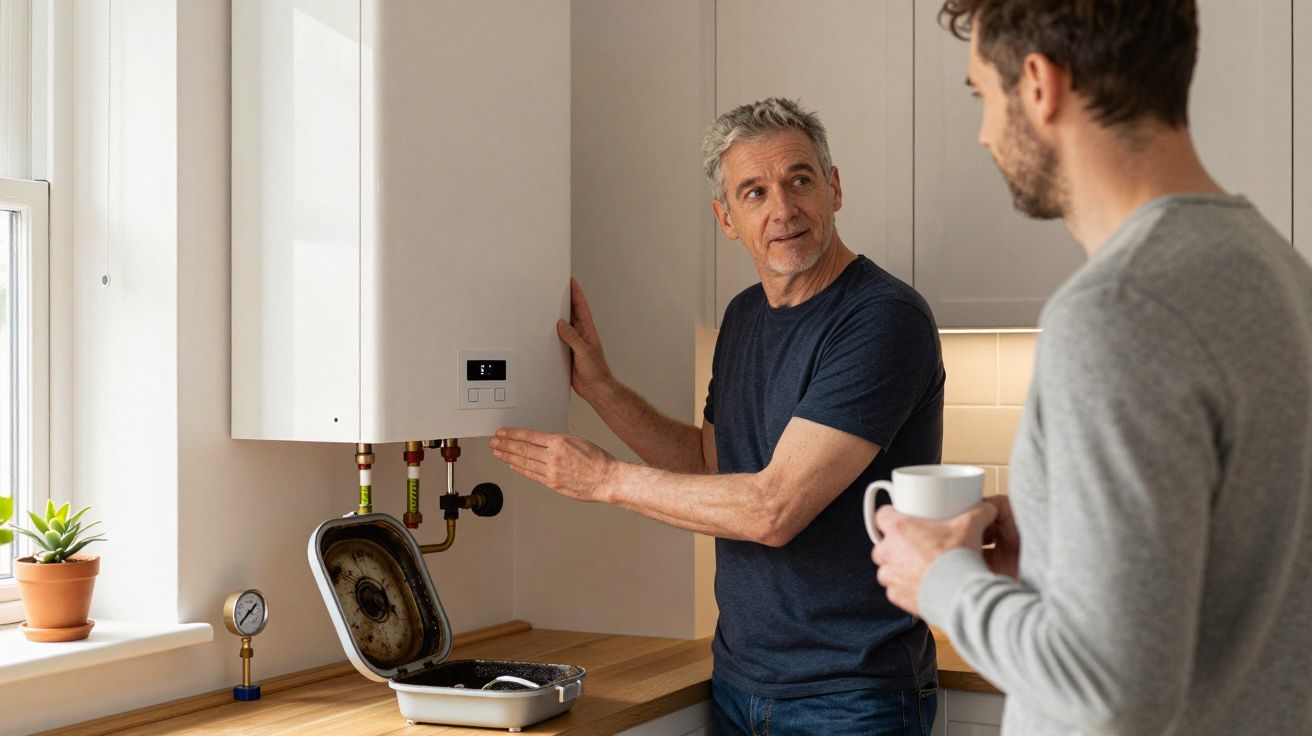
On a wet Wednesday in Leeds, I watched a service engineer stand in front of a wall-hung boiler like it was a shy animal. He didn’t start with a spanner. He started with silence, eyes on the display, letting the system tell him what it thought was wrong. The homeowner hovered with a mug of tea, half apologising as if the boiler’s mood was somehow personal.
He pressed two buttons, waited, and the boiler woke, then stopped again with the same blunt code. “It’s not that they’re worse,” he said. “It’s that they’re less tolerant.”
When “less forgiving” is actually the design doing its job
Old heating systems had slack in them. A tired pump might wheeze along for weeks, a sooty burner might still light, a slightly off mixture might simply burn a bit dirtier. They were crude, but they had room to be imperfect.
Modern kit aims to be cleaner, safer, and more efficient - condensing boilers extracting extra heat, fans controlling air, sensors checking temperatures, pressures, and flames in real time. That intelligence is the point. But intelligence also means boundaries: if a reading falls outside the safe window, the system refuses to play along.
The homeowner experiences this as drama. The engineer experiences it as logic. A lockout isn’t a tantrum; it’s the machine saying, “I can’t prove this is safe, so I’m stopping.”
The small chain reactions nobody sees
Most “sudden” failures aren’t sudden. They’re a small change that forces the system to reveal a weakness that was already there.
A few common examples engineers recognise instantly:
- A minor pressure drop from a slow leak, which trips a low-pressure switch on a cold night.
- A condensate pipe that freezes outside, causing the boiler to lock out rather than flood itself.
- A dirty magnetic filter starving the heat exchanger of flow, leading to overheat trips.
- A fan beginning to slow, which upsets the air pressure proving and prevents ignition.
- A room thermostat or smart controller losing signal, so the boiler never gets a clean “run” request.
In older systems, these were annoyances. In modern ones, they’re a chain reaction: one sensor flags something odd, another refuses the sequence, and the whole thing shuts down in a way that feels unforgiving because it is.
Why engineers “quietly watch” before they touch anything
There’s a particular moment on a call-out when an engineer does almost nothing. They let the boiler attempt a start: fan spin, checks, ignition, flame prove, ramp up, then-maybe-lockout. To a homeowner it looks like stalling. To the person fixing it, it’s the quickest way to narrow the fault without guessing.
That watching is a test. It answers questions like:
- Does it fail before ignition or after flame?
- Does it fail only on hot water, only on heating, or both?
- Do the temperatures rise too fast (flow issue) or not at all (combustion/ignition issue)?
- Does the pressure change when it tries to run (expansion vessel, PRV, leaks)?
Then comes the boring bit: checking the simple physical realities that software can’t fix. Is the condensate flowing? Is the flue terminal clear? Is the system pressure sensible? Is the filter clogged? Has someone half-closed a radiator valve during “a quick tidy”?
“People assume it needs a new board,” one engineer told me, turning a filter magnet black with sludge. “Most of the time it needs the basics put back in order.”
The hidden cost of cleverness: more points of failure, fewer safe shortcuts
Complexity doesn’t just add features. It adds dependencies.
A modern heating system is often a web: boiler, programmer, smart thermostat, TRVs, weather compensation, zone valves, pumps, sensors, and sometimes a heat pump or hybrid control trying to coordinate it all. Each part might be fine on its own. The friction appears in the joins: timing, signalling, flow rates, and assumptions about how the house behaves.
This is why a “minor change” can cause weird new symptoms:
- Adding smart TRVs can reduce flow so far that the boiler short-cycles.
- A new radiator can disturb balancing, pushing return temperatures out of the condensing sweet spot.
- A system flush can dislodge debris and block a plate heat exchanger.
- A replacement thermostat can be wired correctly yet configured wrongly (relay logic, hysteresis, load compensation).
Nothing is “broken” in the dramatic sense. The system has simply become less able to absorb human messiness.
The gentler approach: treat it like a system reset, not a battle
Homeowners often respond to lockouts with repeated resets, like tapping a stuck screen. Occasionally you get lucky. More often you stress components and hide the pattern an engineer needs to see.
A calmer, more useful routine looks like this:
- Check system pressure (when cold) and top up only to the manufacturer’s range.
- Listen for obvious flow problems: gurgling, kettling, radiators cold at the bottom.
- If it’s freezing weather, inspect condensate routes that run outside (without dismantling anything).
- Note when it fails: hot water draw-off, first call for heat, overnight, after TRVs close.
- Stop after one reset and write down the fault code; patterns matter more than hope.
None of this replaces a proper service. But it turns the situation from panic into information, which is the difference between “swap parts until it works” and “fix the actual cause”.
“The best boilers are like careful drivers,” an engineer said. “They brake early. That feels annoying until you remember what they’re avoiding.”
| Point clé | Détail | Intérêt pour le lecteur |
|---|---|---|
| Modern systems enforce safe limits | Sensors stop operation when readings drift | Fewer dangerous “limping along” scenarios |
| Complexity creates fragile joins | Controls, flow, and configuration interact | Explains odd, intermittent faults |
| Observe before resetting | Fault codes + conditions reveal the cause | Faster, cheaper diagnosis |
FAQ:
- Why does my boiler lock out instead of “just working”? Modern boilers run constant safety checks. If they can’t confirm safe ignition, correct airflow, adequate pressure, or proper heat removal, they shut down to prevent damage or risk.
- Is repeatedly pressing reset a bad idea? One reset can be reasonable. Repeated resets can mask the pattern, stress ignition components, and delay the real fix-especially if there’s a condensate blockage or low flow.
- What’s the most common reason heating fails on a very cold night? Frozen condensate pipes are a frequent culprit for condensing boilers, along with pressure drops that only show up when the system is working hard.
- Why did things get worse after I fitted smart controls? Smart TRVs and scheduling can reduce system flow or change cycling behaviour. Without correct balancing or bypass arrangements, the boiler may short-cycle or overheat.
- What information helps an engineer most on a call-out? The fault code, system pressure (cold), when the fault happens (hot water vs heating), and any recent changes (new thermostat, radiator work, power cuts).





Comments (0)
No comments yet. Be the first to comment!
Leave a Comment