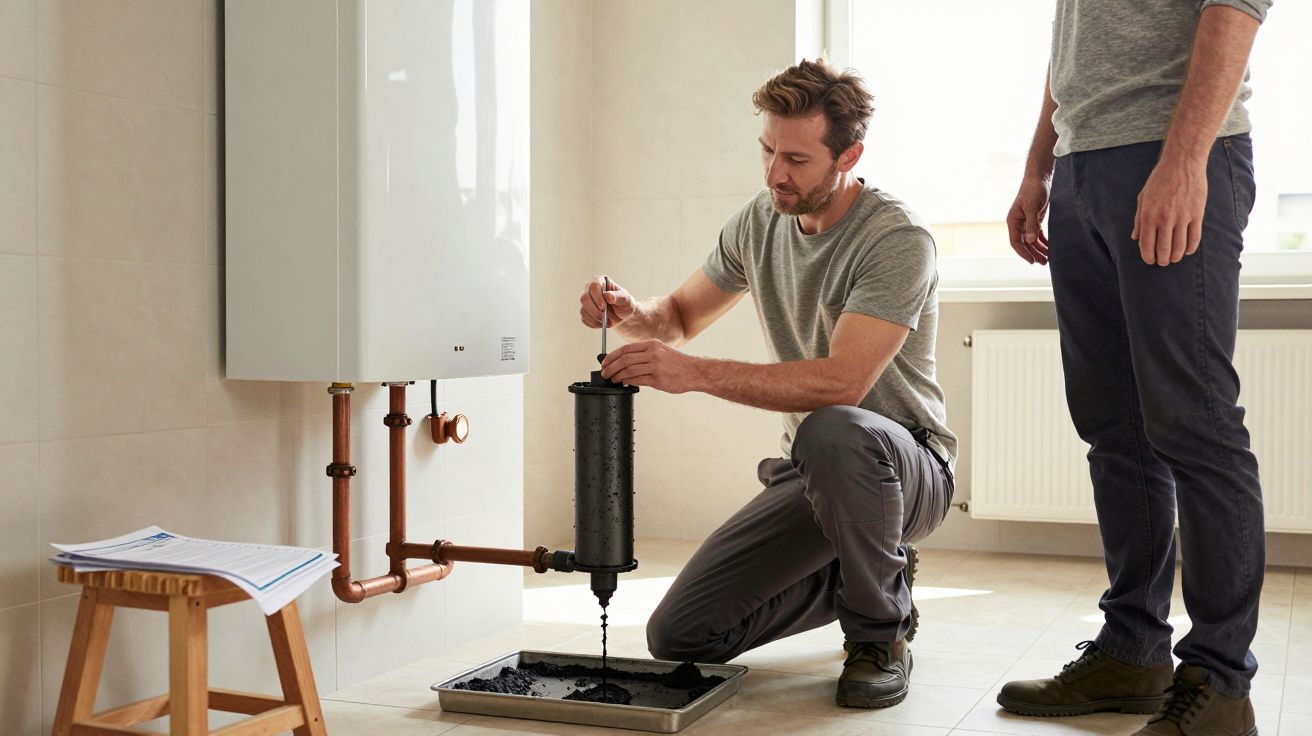
Magnetic filters sit quietly in the pipework of heating and cooling systems, catching the tiny iron-rich debris that circulates when metal components wear. For anyone who cares about sludge prevention-homeowners, landlords, facilities teams-they’re one of those additions you only notice when you don’t have one. The relevance is blunt: less muck moving around the system usually means fewer breakdowns, steadier heat, and fewer “why is that radiator cold again?” weekends.
You can go years without thinking about the water inside a sealed system. Then a pump starts whining, a boiler trips, or a new radiator never quite gets hot at the bottom. That’s often the moment people learn what magnetite looks like: a soft, black sludge that behaves like grit, but sticks like paint.
The invisible problem: why systems foul up slowly
Modern heating systems are meant to be closed loops, but “closed” doesn’t mean “clean”. Oxygen sneaks in through top-ups, microleaks, and installation work; metals react; corrosion products form. Add limescale in hard-water areas, and you get a mixture that narrows waterways, insulates heat exchangers, and stresses moving parts.
The annoying part is how normal it can look at first. A system can still heat the house while it’s quietly losing efficiency, forcing pumps to work harder and boilers to cycle more often. By the time you feel the symptoms, you’re already paying for the mess in electricity, gas, and call-outs.
What magnetic filters actually do (and what they don’t)
A magnetic filter is essentially a trap with a strong magnet, placed where the circulating water has to pass through it-often on the return near the boiler. As water flows, magnetic particles (mainly magnetite) get pulled out of circulation and held inside the unit rather than grinding through pumps and heat exchangers.
They don’t do everything, and it’s worth being plain about that:
- They’re best at capturing ferrous debris (iron-based particles).
- They don’t “cure” a system that’s already heavily sludged without cleaning.
- They don’t replace inhibitor chemicals; they work alongside them.
- They can’t fix underlying causes like repeated fresh-water top-ups or poor installation.
Think of them less as a miracle and more as a seatbelt. Most days, you forget it’s there. The day something goes wrong, you’re glad it was.
Why they “save systems” quietly
A lot of heating protection is about removing small stresses before they become expensive ones. Magnetic filters work in that unglamorous zone. They reduce abrasion inside pumps, lower the chance of debris blocking small channels in modern boilers, and help radiators stay clearer at the bottom where sludge likes to settle.
If you’ve ever watched an engineer service one, the effect is hard to unsee. The collected material can look like black toothpaste-fine, heavy, and exactly the sort of thing you don’t want passing through a heat exchanger designed with narrow waterways.
In practical terms, the “quiet saving” tends to show up as:
- more consistent radiator temperatures,
- fewer pump and valve issues,
- less frequent need for powerflushing,
- better odds that a new boiler stays healthy long enough to justify its cost.
Where they matter most
Not every property has the same risk profile. Some systems are naturally more prone to building up debris, especially where there’s a mix of metals and lots of moving parts.
Magnetic filters tend to pay for themselves faster when:
- the system is older or has had repeated repairs and radiator swaps,
- there’s a new boiler connected to old pipework and radiators,
- you’ve had symptoms of sludge (cold spots, noisy boiler, slow warm-up),
- the property is large enough that circulation issues show up quickly.
They can still be worthwhile on new installs, but their value is easiest to explain in systems with history-because history leaves residue.
Installation and upkeep: the bit people forget
The filter only helps if water actually flows through it, and if someone empties it occasionally. That sounds obvious, yet many filters go untouched for years, at which point the system is back to carrying debris-just with a very full trap sitting nearby.
A sensible routine is simple and boring:
- Fit the filter in an accessible place, not hidden behind boxing where nobody wants to open it.
- Clean it at commissioning, then again after the first few weeks if the system was old or disturbed.
- Move to an annual clean as part of a boiler service (or at least check it).
- Keep inhibitor levels correct, especially after draining down.
“Protection” only counts if it’s maintained. A neglected filter is still better than none, but it shouldn’t become another forgotten component.
A quick reality check: filter vs. flushing vs. inhibitor
People often treat these as competing options when they’re really parts of one strategy. If a system is already sludged, a filter won’t magically un-block radiators; it will, however, catch what gets loosened later and stop the problem rebuilding as quickly.
| Tool | What it’s good at | What it can’t do alone |
|---|---|---|
| Magnetic filter | Capturing circulating magnetite | Removing heavy, settled sludge |
| Powerflush/chemical clean | Lifting existing deposits | Preventing recontamination long-term |
| Inhibitor | Slowing corrosion formation | Catching debris already in the water |
The calmest outcome usually comes from combining them: clean when needed, protect continuously, and keep chemistry in check.
What to watch for if you suspect sludge
Sludge rarely announces itself with one clear sign. It’s more like a pattern of small irritations that stack up.
Common tells include:
- radiators hot at the top but cool at the bottom,
- a boiler that kettles, cycles, or throws fault codes more often,
- a pump that’s louder than it used to be,
- repeated bleeding/top-ups (often a clue that fresh oxygenated water is being added),
- dirty water when draining a radiator or changing a valve.
None of these proves sludge on its own. Together, they’re usually the system asking for attention before it demands it.
FAQ:
- Do magnetic filters work on all heating systems? They’re most common on sealed wet central-heating systems with radiators, and they’re especially useful where there are ferrous components. They’re less relevant where there’s minimal iron content.
- Will a magnetic filter fix cold radiators? It can help prevent recurrence, but cold spots caused by settled sludge often need cleaning (and balancing) first.
- How often should a magnetic filter be cleaned? Typically at installation/commissioning, then periodically-often annually with servicing. Older systems may need more frequent early cleans.
- Is a filter enough for sludge prevention on its own? Not usually. Best practice is a filter plus correct inhibitor levels and addressing causes like leaks and frequent top-ups.
- Do they reduce energy bills? They can, indirectly, by keeping heat transfer and circulation closer to design performance-especially in systems that were already starting to foul.






Comments (0)
No comments yet. Be the first to comment!
Leave a Comment