You can feel it before you can name it: the way the hot tap takes a beat longer, the boiler’s hum turning slightly harsher, the radiator that never quite gets to the edges. Plumbers call these maintenance signals, and early detection is the difference between a cheap adjustment and a Saturday emergency call-out. If you know what they look like in real homes, you can act while the system is still being polite.
I’ve stood in enough airing cupboards to recognise the moment a homeowner starts apologising to the boiler, as if manners might keep it going. The truth is simpler. Failing systems announce themselves early - just not with flashing lights.
The first thing a plumber listens for (and it’s not the banging)
Most people wait for drama: clanking pipes, a dead shower, a puddle. A plumber usually starts quieter, with the sound and rhythm of the system doing its normal job. A boiler that fires, stops, then fires again in short bursts is telling you it can’t settle - often flow, pressure or a sensor issue rather than “it’s old, mate”.
Then there’s the feel of heat. Uneven radiator warmth, or a hot flow pipe with a lukewarm return, is a classic “something’s slowing down” signal. It might be air, sludge, a sticking valve, or a pump beginning to struggle.
“Systems don’t just fail,” one installer told me. “They get inefficient first. That’s your warning label.”
Pressure, patterns, and the lies the gauge tells
A pressure gauge can be reassuring, which is exactly why it misleads. Plenty of faults sit behind a “normal” number. What matters is the pattern: are you topping up every few days, or is it rock-solid for months?
Frequent pressure drops are one of the loudest maintenance signals in sealed central heating. Sometimes it’s a tiny leak that evaporates before it stains anything. Sometimes it’s an expansion vessel that’s lost its charge, so pressure swings wildly as the system heats and cools.
A practical tell: if the pressure climbs when the heating is on and falls hard when it cools, that’s not “just how it is”. That’s a system struggling to buffer normal expansion.
What to note before you call anyone
- The cold pressure reading (first thing in the morning is ideal).
- The hot reading after 30–60 minutes of heating.
- Whether you’ve had to use the filling loop recently.
- Any dripping from the PRV outlet pipe (often outside).
Those four details save time, and they stop you paying for guesswork.
Hot water that goes moody: the early signs people normalise
Combi boilers fail in familiar ways, and households adapt with grim creativity. Someone learns to “run the hot tap for a minute first”. Someone else showers at a very specific angle to avoid the cold spike.
Temperature swings are a headline maintenance signal because they’re often caused by restrictions and sensors getting confused - scaled plate heat exchangers in hard-water areas, sticky diverter valves, partially blocked inlet filters. The system is telling you it can’t modulate smoothly.
Low hot-water flow is another. People call it “pressure”, but it’s frequently flow rate. A showerhead choked with limescale can mimic bigger faults, and a plumber will usually check the simple bottleneck before condemning the boiler.
Radiators: what the cold patches are really saying
A radiator that’s hot at the top and cold at the bottom isn’t being quirky; it’s storing trouble. That pattern often points to sludge settling out - magnetite and debris that reduce heat transfer and narrow down pipes where you can’t see it.
Cold at the top can still be air, and bleeding may help. But if you’re bleeding regularly, that’s not “maintenance”, that’s the symptom: you’re introducing oxygen, or there’s a leak drawing air in somewhere.
If one radiator is always worse than the others, a plumber will suspect balancing, a partially closed lockshield, or a stuck thermostatic radiator valve (TRV). If all radiators are slow and uneven, that’s when talk turns to circulation and system cleanliness.
A quick “don’t fool yourself” checklist
- One cold radiator: likely local (valve/balance/air).
- Several cold bottoms: likely sludge and poor circulation.
- Repeated air in rads: likely leak, corrosion, or expansion issues.
- Boiler kettling noise: often scale/flow restriction, not “it’s about to explode”.
The small drips and stains that matter more than the big puddle
Plumbers don’t only look at the boiler; they look around it. Green staining on copper, crusty white deposits, rusty marks under valves - those are time-lapse videos of tiny leaks. They matter because they usually come with corrosion, and corrosion doesn’t stay courteous.
Condensate pipework tells its own story. In winter, a frozen condensate line can stop a boiler dead, but the earlier signal is often gurgling, slow drainage, or a previous “temporary” patch. The fix is usually boring: correct fall, insulation, sensible routing. Boring is good.
How plumbers decide what’s urgent (and what can wait)
Not every symptom is an emergency. The skill is triage: what’s dangerous, what’s damaging, what’s annoying.
Here’s how it tends to break down in real visits:
| Sign | What it often means | How fast to act |
|---|---|---|
| Smell of gas, sooting, yellow flames | Combustion fault | Immediately (call Gas Emergency) |
| PRV discharge or rapid pressure swings | Expansion/overpressure issue | Soon (days) |
| Cold spots, noisy rads, frequent bleeding | Air/sludge/circulation | Plan it (weeks, but don’t ignore) |
Urgent doesn’t always mean expensive. It just means the system is in a state where it can damage itself, or you.
A simple habit that catches most problems early
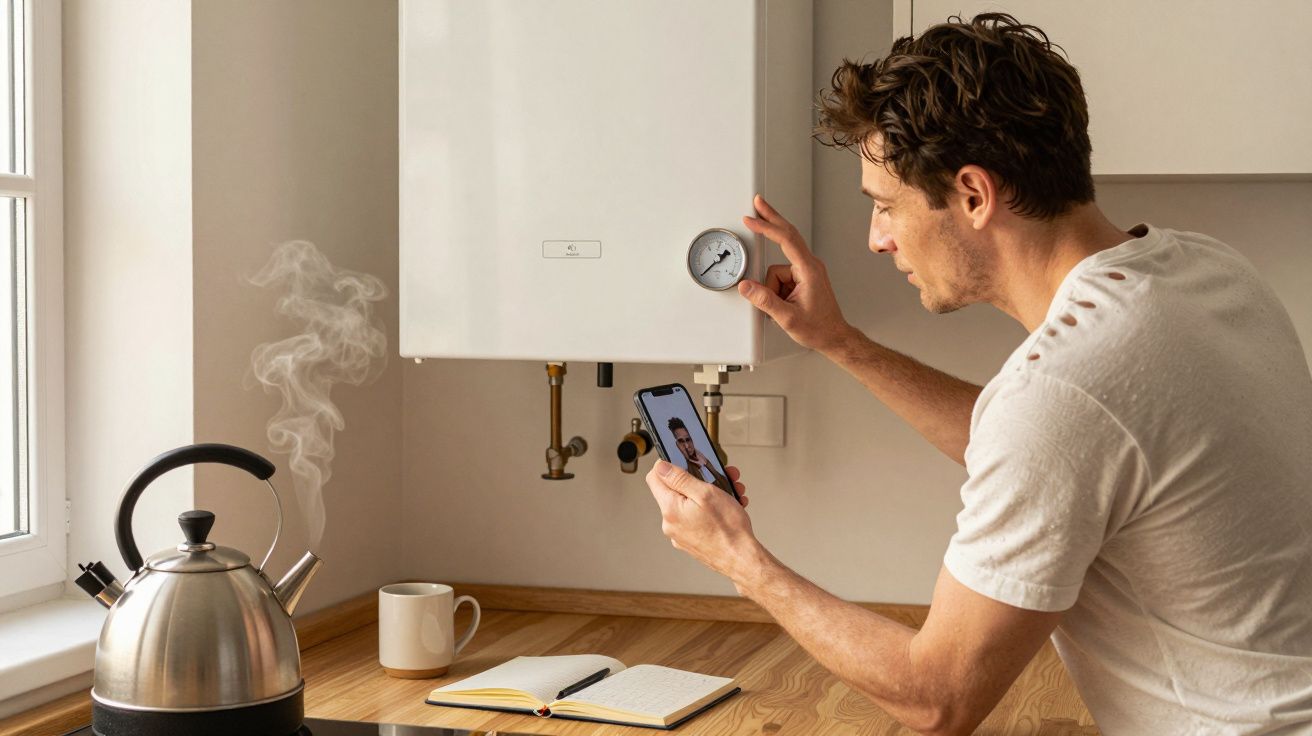
Early detection isn’t a gadget; it’s a two-minute routine. Once a month, when you’re already in the kitchen waiting for the kettle, glance at the boiler pressure (if you have a combi), and notice how long hot water takes to stabilise. Once a season, walk past the radiators when the heating’s been on for half an hour and feel for cold bottoms.
If you want to be even more useful to your future self, take a photo of the pressure gauge on a “good” day. Baselines beat memory.
The pitfalls: what people do that makes plumbers wince
Masking symptoms is incredibly human. It’s also how small problems become big invoices.
- Topping up pressure constantly without asking why (you’re feeding oxygen into the system).
- Cranking the thermostat to “force it” (it won’t fix flow, it just stresses components).
- Bleeding radiators every week as if it’s normal (it’s not).
- Ignoring limescale restrictions until you blame the boiler for a showerhead problem.
Contact time beats elbow grease in cleaning; in heating, attention beats panic. Notice early, act calmly.
FAQ:
- What are the most common maintenance signals in a heating system? Repeated pressure drops, uneven radiator heat (especially cold bottoms), hot water temperature swings, and boiler short-cycling are the big ones plumbers notice early.
- Does early detection really save money, or is that just sales talk? It often saves money because many faults start as restrictions, minor leaks, or failing components that are cheaper to fix before they damage pumps, heat exchangers, or electronics.
- Should I keep topping up the boiler pressure if it keeps dropping? Topping up once to restore heat is fine, but repeated top-ups mean there’s a fault to find. Constantly adding water can accelerate corrosion and sludge.
- Is a noisy boiler always serious? Not always, but new noises are meaningful. Kettling, whistling, or rapid firing on/off often points to scale or poor flow, which should be checked before it escalates.
- When do I need a professional immediately? Any suspected gas smell, signs of sooting/poor combustion, or water leaking near electrics needs urgent attention. For comfort issues like cold spots, book it in before winter bites.





Comments (0)
No comments yet. Be the first to comment!
Leave a Comment