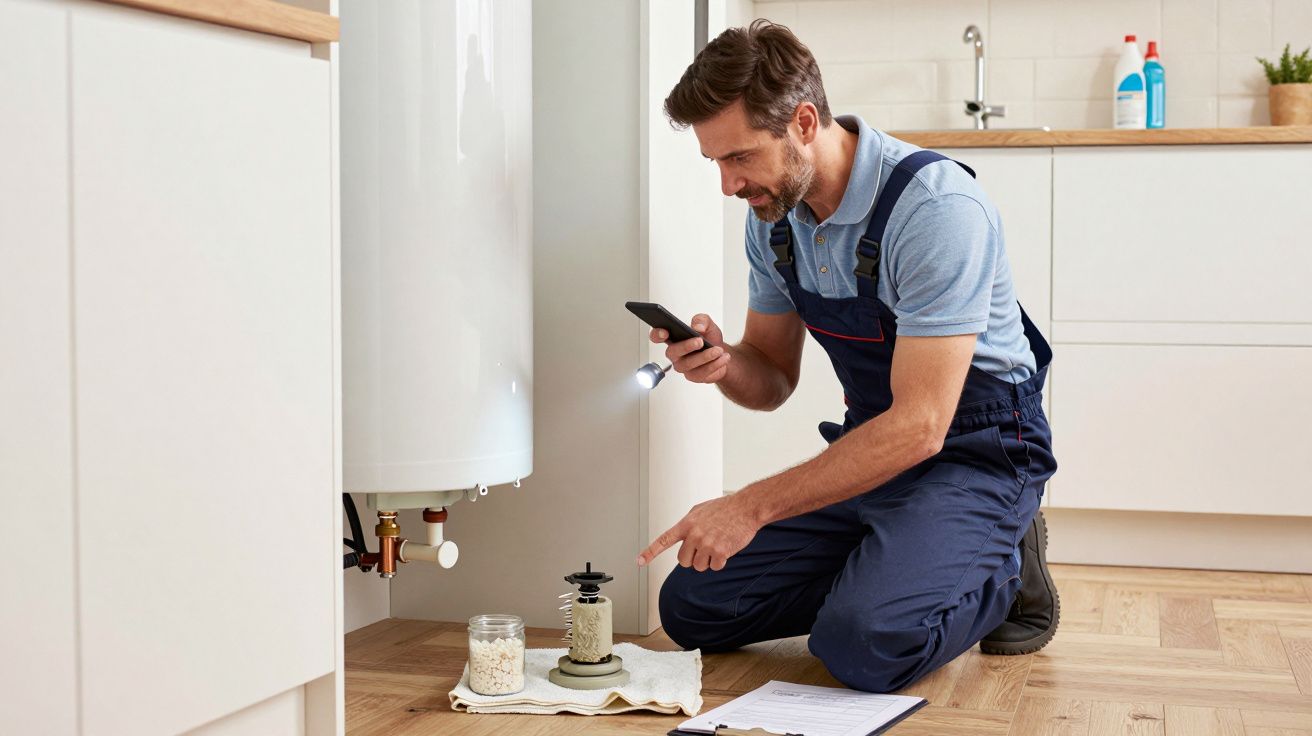
Cylinder scaling is the slow build-up of limescale inside a hot water cylinder, common in UK homes with hard water and older heating setups. It triggers performance loss in ways you rarely notice day to day: longer heat-up times, weaker flow at taps, and higher bills for the same comfort. The reason it matters is simple-once scale gets established, efficiency drops quietly while parts work harder and fail sooner.
You can live with it for years without a dramatic “breakdown” moment. Engineers often see it when they open a cylinder for something else and find a chalky lining that explains months of lukewarm showers and noisy pipework.
Why this problem grows without a warning light
A boiler usually tells you when it is unhappy. A hot water cylinder often does not. Scaling forms in thin layers, and each layer acts like insulation between the heating surface and the water you actually want hot.
That means the system compensates. It heats for longer, cycles more often, and pushes higher temperatures at components that were designed for steadier work. You feel a small change, then adapt, then pay for it.
The silent part is the danger: scale rarely stops on its own, and the system tends to “mask” the loss by running harder.
What cylinder scaling actually does inside the tank
Scale is mostly calcium carbonate that drops out of water when heated, especially in hard-water areas across the South and East of England. It settles on heating surfaces and collects at the bottom as sediment.
Over time, three practical effects show up:
- Heat transfer drops: the element or coil heats the scale first, not the water.
- Useful capacity shrinks: sediment takes up space and disrupts circulation.
- Wear increases: thermostats, elements, pumps and valves see more strain.
If you have an immersion heater, the element can end up crusted like a kettle. In indirect cylinders (heated by a boiler), the coil can scale up too, reducing the rate at which stored water reaches temperature.
The signs most people miss (or explain away)
Cylinder scaling rarely presents as a single clear symptom. It’s usually a cluster of small annoyances that arrive slowly enough to feel normal.
Look out for:
- Hot water that runs out sooner than it used to
- Longer reheat times, especially after a bath or multiple showers
- Kettling/rumbling noises from the cylinder area when heating
- Tap aerators and showerheads clogging more frequently
- A boiler that seems fine, but the hot water side feels sluggish
None of these confirm scale on their own. Together-particularly in a hard-water postcode-they are enough to justify a check before a winter failure forces your hand.
Where engineers see the real cost: performance loss
When engineers talk about performance loss, they often mean “the house still has hot water, but it takes longer and costs more”. That is the awkward middle ground where many systems sit for years.
Here is how it tends to show up in practical terms:
| What you notice | What may be happening | Why it matters |
|---|---|---|
| Hot water takes ages | Heating surface insulated by scale | Higher energy use, more cycling |
| Showers cool quickly | Reduced effective cylinder volume | Comfort drops, demand feels “spiky” |
| Noises when heating | Localised boiling against scale | Accelerates element/coil wear |
The bills rise first, then the inconvenience, and only then the breakdown risk. By the time an immersion element fails or a valve sticks, the scale has usually been there for a long while.
Why some homes scale faster than others
Hard water is the main driver, but it is not the only one. Heat and flow patterns matter too: high storage temperatures and frequent reheats can accelerate deposition.
Common accelerators include:
- Running stored hot water very hot “to be safe” without checking the setpoint
- Oversized cylinders that heat and reheat large volumes you do not actually use
- Properties with high hot-water demand (larger households, frequent baths)
- Older systems with no water treatment and little maintenance history
If you live in a hard-water area and the cylinder is more than a few years old, assume some level of scaling unless proven otherwise.
What you can do without guessing or overpaying
You do not need to panic-replace a cylinder at the first hint of lime. But you do want a plan that matches the kind of cylinder you have and the level of scaling likely inside it.
A sensible, low-drama approach:
- Confirm water hardness for your area (your water supplier usually publishes it).
- Check cylinder type and age: vented vs unvented, immersion vs indirect coil.
- Ask for evidence: when an engineer attends, request photos of the element/inspection point where possible.
- Consider water treatment: scale reduction is often cheaper than repeated call-outs.
If you have an unvented cylinder, do not DIY internal work. These are pressurised systems with safety controls that must be maintained correctly.
Prevention that actually holds up in UK homes
Most households get the best results by combining sensible temperature control with proper scale management.
- Keep hot water storage at a safe, appropriate temperature (follow guidance for legionella control while avoiding excessive overheating).
- Fit or maintain a scale reducer/conditioner where appropriate, especially in very hard-water areas.
- Do annual servicing for unvented cylinders to ensure safety devices operate correctly.
- Flush and clean system components when recommended, rather than waiting for flow problems.
The goal is not “perfectly scale-free”. It is stopping slow, compounding loss before it turns into a costly replacement decision.
When to escalate: repair, descale, or replace
There is a point where minor measures are no longer enough. If hot water recovery is consistently poor, noise is pronounced during heat-up, or components keep failing, you may be paying repeatedly for symptoms rather than fixing the cause.
Escalate to a qualified engineer if:
- You have an unvented cylinder that has not been serviced in over a year
- The cylinder is heating but hot water does not last
- Rumbling/kettling is persistent during heat cycles
- Immersion elements fail more than once, or thermostats trip repeatedly
A good contractor will talk in probabilities, not promises: how severe the scaling appears, what can realistically be cleaned, and whether prevention will meaningfully slow future build-up.
FAQ:
- Is cylinder scaling just a “hard water” problem? Hard water is the main cause, but high storage temperatures, frequent reheats and older untreated systems can speed it up.
- Can I ignore it if I still get hot water? You can, but performance loss typically means higher running costs and greater wear on elements, valves and controls.
- Does a water softener fix it completely? It can greatly reduce new scale formation, but it won’t magically remove existing deposits inside a cylinder without additional work.
- Is it safe to descale an unvented cylinder myself? No. Unvented systems are pressurised and have safety devices that must be serviced by a qualified engineer.




Comments (0)
No comments yet. Be the first to comment!
Leave a Comment