The first time you need water isolation valves, you rarely have the calm to go looking for them. A pipe lets go, a cistern keeps filling, the kitchen tap won’t stop running, and suddenly “emergency control” stops being a vague idea and becomes the only thing you care about. Most homes have more shut-offs than people realise - yet most people couldn’t point to a single one without guessing.
It’s not negligence. It’s just that valves are quiet when life is normal. They sit behind toilets, under sinks, inside little plastic hatches, half-hidden by cleaning products and the dull assumption that nothing will ever leak today.
Then something drips for a week. Then it runs for a night. Then it finds the one gap in the floor where water can travel without being seen.
The moment a valve matters (and why it’s often too late)
Leaks rarely announce themselves with drama. They start as a soft hiss you blame on the radiator, a damp patch you assume is condensation, a cupboard that smells “a bit musty”. In flats, water can move sideways before it moves down. In houses, it can soak chipboard, swell skirting, and rot the back of units while the front still looks fine.
The tragedy is simple: a working isolation valve turns a multi-room incident into a minor clean-up. A seized or unknown valve turns minutes into hours. And hours is when damage spreads - into plaster, electrics, neighbour ceilings, and insurance phone calls that begin with, “We didn’t know where the stop tap was.”
You don’t need to be a plumber to avoid that. You just need one boring piece of knowledge, practised once while nothing is happening.
Where the “nobody checks” valves actually live
People picture one heroic shut-off: the main stop tap under the kitchen sink. Sometimes that’s true. Often it isn’t. Modern plumbing is full of small, local valves designed so you can isolate one fitting without shutting off the whole property.
A quick home sweep usually finds these:
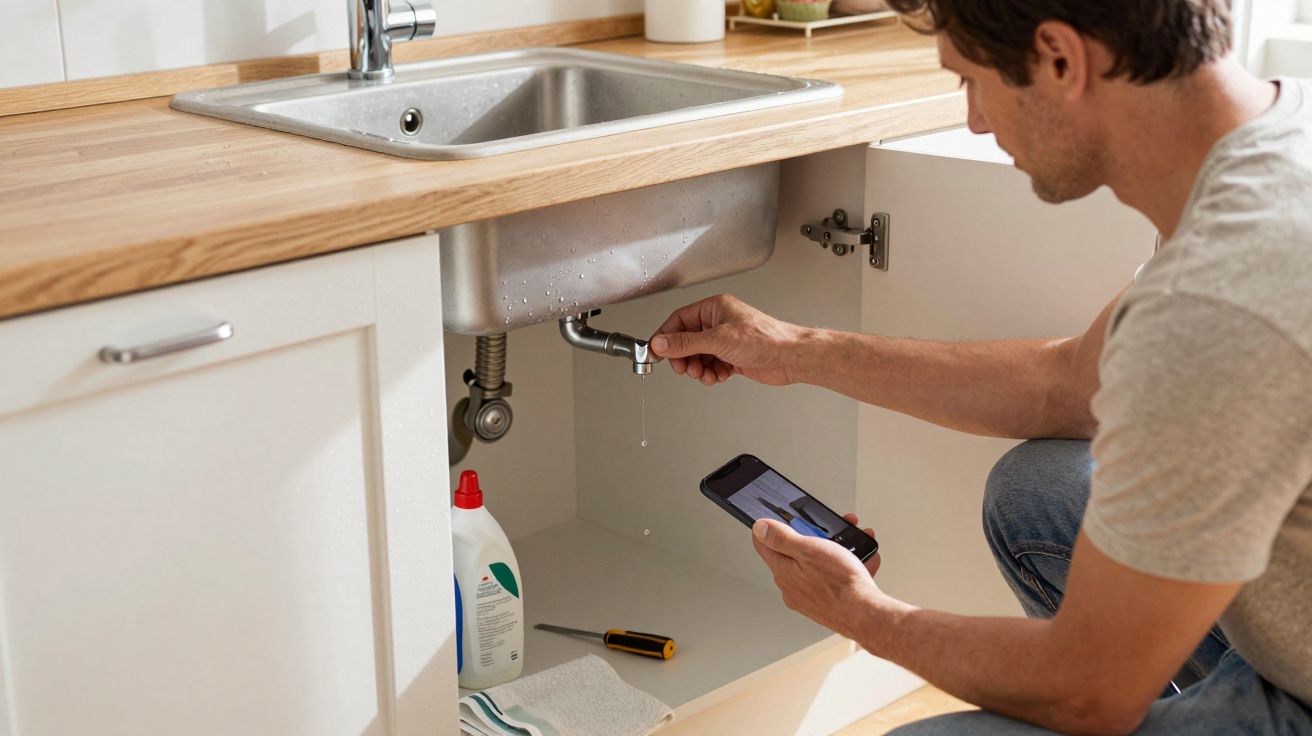
- Under the kitchen sink: hot and cold feeds to the mixer, plus appliance valves for dishwasher or washing machine.
- Behind the toilet pan or in the cistern area: a small valve on the supply line (sometimes in a boxed-in void).
- Under bathroom basins: two small valves on the pipework feeding the taps.
- Near the hot water cylinder or boiler: service valves that isolate parts of the system (varies by setup).
- At the boundary or meter cupboard: sometimes an external shut-off, especially in newer builds.
The catch is that “find it” isn’t the same as “it works”. Valves can seize. Handles can snap. Slot-head types can be stiff enough to round off. And the time you discover that is almost always the time you’re holding towels to a leak.
A five-minute check that can save you a full repair
Pick a quiet moment. Don’t do this with guests arriving, don’t do it at 11 p.m., and don’t do it for the first time when your floor is already wet. Make it boring on purpose.
- Locate the main stop tap (where water enters the property). If you’re not sure, start at the kitchen sink cupboard and follow pipework; if it’s a flat, check utility cupboards and near the water heater.
- Turn it off gently - clockwise is usually off. If it won’t move, stop forcing it and plan a proper fix rather than breaking it.
- Open the cold tap at the kitchen sink to confirm flow stops, then let pressure release for a few seconds.
- Turn the stop tap back on slowly. Listen for hammering; sudden re-pressurising can jolt old pipework.
- Now test one local isolation valve (toilet or basin) the same way: close it, check the tap/toilet stops filling, then reopen.
That’s it. No heroics. No dismantling anything. You’re not trying to service the plumbing - you’re checking whether your emergency control actually controls anything.
If you’re in a hard-water area, this matters even more. Scale builds quietly where you don’t look, and valves are exactly the kind of component that can go from “fine” to “immovable” over a few years.
The small habits that stop leaks becoming “a situation”
Most damage isn’t caused by the leak itself. It’s caused by delay: the leak that wasn’t noticed, the shut-off that didn’t shut off, the panicked hunt for a valve while water keeps feeding the problem.
A few low-effort habits shift the odds:
- Keep access clear: don’t pack the stop tap cupboard so tightly you can’t reach the valve without unloading bottles and bins.
- Label what you find: a small tag or bit of tape on the pipe (“Toilet cold”, “Kitchen hot”) saves future-you.
- Turn valves once or twice a year: not to “exercise” them obsessively, just to stop them freezing in one position.
- Know your tools: if you have slot-head isolation valves, keep a suitable flat screwdriver nearby; if the main stop tap is stiff, a stop tap key can help.
- Teach the household: if you live with others, show them where the main shut-off is. In an emergency, you might be out.
It sounds overcautious until the day it isn’t. Flooding is one of those domestic problems where competence is mostly location knowledge.
When you find a valve that won’t move
This is the part people skip because it’s annoying. Yet a seized valve is not a neutral finding; it’s a warning. It means your “off switch” might be decorative.
If a valve won’t budge:
- Don’t force it until something snaps. A broken valve during a “test” is still a leak you created.
- Check if it’s the right type: some isolation valves have a quarter-turn lever; others need a screwdriver. Some stop taps have a small locking collar.
- Plan a replacement if it’s corroded, weeping, or stiff. A plumber can swap an isolation valve quickly, and it’s usually cheaper than drying out a floor.
- If the main stop tap is problematic, prioritise it. Local valves are useful, but the main shut-off is the one you need when everything else fails.
There’s a particular kind of frustration in discovering, mid-incident, that the valve you’ve just found is purely symbolic. Avoiding that moment is the whole point of checking early.
The quiet logic: containment beats repair
Water is patient. It finds joints, gaps, and edges. It soaks into materials that look solid until they’re not, and it makes a mess that rarely matches the size of the original fault. In that sense, water isolation valves aren’t plumbing trivia - they’re boundary-setting tools for your home.
If you know where they are, can reach them, and have confirmed they work, most “disasters” become interruptions. If you don’t, the same fault gets extra time to spread.
| Point clé | Détail | Intérêt pour le lecteur |
|---|---|---|
| Valve known and working | Main shut-off + one local valve tested | Stops water fast when it counts |
| Access and labelling | Clear cupboards, simple tags | Saves panic-minutes in a leak |
| Stiff valve = warning | Don’t force, replace promptly | Prevents failure during an emergency |
FAQ:
- Where is the main stop tap usually found? Commonly under the kitchen sink, in a utility room, under the stairs, or in a service cupboard in flats. Some properties also have an external shut-off near the meter.
- Should I turn isolation valves fully off and on to “exercise” them? Yes, gently, once or twice a year is usually enough. The goal is simply to confirm movement and function, not to constantly fiddle with them.
- What if turning off the stop tap doesn’t stop the water? You may be turning the wrong valve, the stop tap may have failed internally, or there may be a secondary feed (rare, but possible in some setups). Treat it as urgent to investigate and repair.
- Is it safe to use a lot of force on a stuck valve? No. Forcing can snap handles or damage seals, creating a leak. If it’s stiff or corroded, plan a controlled replacement.
- Do I need separate valves for appliances like washing machines? Ideally, yes. An accessible appliance isolation valve makes it easy to shut off a single hose or machine without taking the whole house off water.




Comments (0)
No comments yet. Be the first to comment!
Leave a Comment