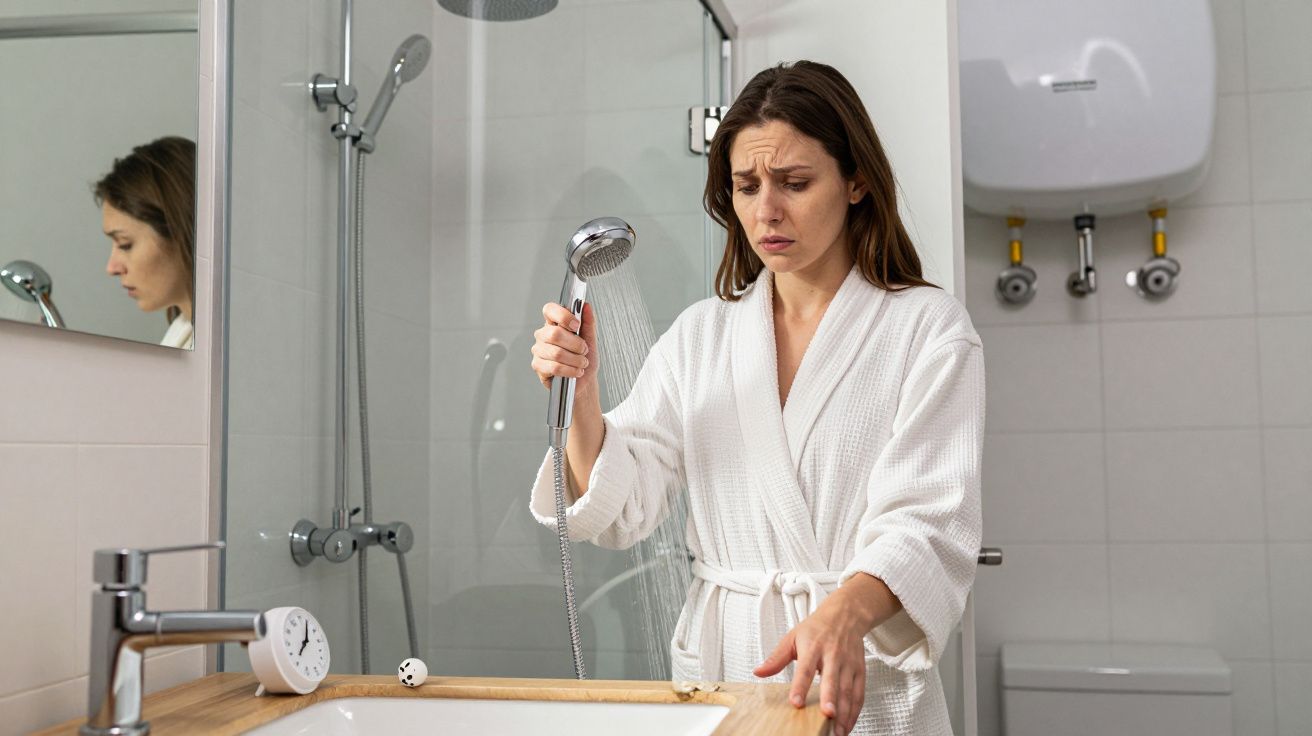
Most people only notice their hot water supply when it’s suddenly missing at the worst possible moment: mid-shower, during school mornings, or when you’ve got guests in the house. What often sits underneath those “random” cold spells is recovery issues - the system isn’t reheating water quickly enough between uses, so it quietly falls behind demand. Spotting the early signals matters because the fix is usually cheaper before a small performance dip turns into a breakdown.
A struggling system rarely fails with a dramatic bang. It more often drifts: a little less pressure, a little less heat, a little more waiting, until you’ve reorganised your routines around it.
When “it’s fine” becomes the new normal
Underperformance tends to look like inconvenience rather than crisis. The shower still works, the taps still run, and the household adapts without realising it’s compensating.
If you find yourself timing showers, running the hot tap “until it gets going”, or avoiding back-to-back uses (shower, dishwasher, laundry), you’re often working around a system that’s lost capacity or speed.
Hot water problems are rarely about one bad day. They’re about a pattern that repeats, especially when demand spikes.
The clearest signs your system can’t keep up
A few symptoms show up again and again across cylinders, combi boilers, heat pumps and instantaneous heaters. Some point to simple maintenance; others hint at parts wearing out.
You run out of hot water faster than you used to
If the first shower is fine but the second turns lukewarm, you’re seeing either reduced stored volume (in a tank/cylinder system) or reduced output (in an on-demand system). Scale build-up, a failing heating element, or incorrect thermostat settings can all shrink “usable hot water” without any obvious leak.
Temperature swings during use
Hot-cold-hot cycling in a shower often indicates flow/pressure instability, a tired mixing valve, or a boiler modulating poorly. In hard-water areas, partially blocked heat exchangers and filters can exaggerate the problem by restricting flow.
The system takes ages to “recover”
Recovery time is the big tell. A healthy setup should rebound in a predictable window; when it doesn’t, the system is either not producing heat efficiently or not transferring it into the water effectively.
Common causes include:
- Limescale insulating the heating surface (so energy doesn’t move into the water well).
- A thermostat or sensor reading incorrectly and cutting heat too early.
- A boiler/heat pump running at reduced output because of faults, low pressure, or poor settings.
Hot water pressure is noticeably weaker than cold
If only the hot side is sluggish, suspect restrictions: scaled-up pipework, a partially closed isolation valve, clogged inlet filters, or a failing pressure-reducing valve. On older systems, internal corrosion can narrow pipes over time and create a slow, creeping decline.
Strange noises: banging, kettling, rumbling
A bit of noise isn’t unusual, but new sounds are information. “Kettling” (a kettle-like rumble or hiss) is often scale on a heat exchanger, causing water to boil in tiny pockets and make that harsh sound.
In cylinders, popping or knocking can come from expansion, sediment shifting, or valves not behaving as they should. The point isn’t the exact noise - it’s that the system is working harder than it used to.
The less obvious clues people ignore
Some warning signs don’t happen at the tap. They show up in energy use, small safety behaviours, and the general “feel” of the system.
Bills rise without any change in routines
When a unit has to run longer to deliver the same hot water, you pay for the inefficiency. This is especially noticeable where scale is heavy, because the heater can be effectively “wrapped” in insulation it didn’t ask for.
You see discoloured water or more debris in aerators
Rusty tinges, grit, or frequent clogging of tap aerators can indicate corrosion or sediment. Sediment in a cylinder reduces effective capacity and can interfere with heating, making the bottom of the tank a cold, unusable zone.
Relief valve discharge or damp patches near the system
Occasional discharge can be normal during heating cycles, but repeated dripping suggests pressure problems, a failing expansion vessel, or a valve that’s no longer sealing. This matters because pressure instability can affect both performance and component lifespan.
A quick “stress test” you can do at home
You don’t need instruments to see whether your hot water is keeping pace. You just need to observe the system under the kind of demand that usually triggers complaints.
Try this on a day you’re home:
- Run a normal shower for the usual time.
- Immediately run the hot tap in the kitchen for a minute.
- Then start another hot-water task (second shower, dishwasher fill, or basin).
If the temperature drops sharply, or you have to wait an unusually long time for heat to return, that’s a practical sign of reduced capacity or recovery issues - even if the system “works” on quiet days.
What typically causes underperformance (and what it often isn’t)
People often assume “it’s the boiler” or “it’s the cylinder” as a whole. More often, it’s a smaller bottleneck that’s been building quietly.
- Scale and sediment: the slow thieves of heat transfer and volume.
- Aging thermostats/sensors: heating stops early, or overshoots then cuts out.
- Blocked filters or partially closed valves: flow drops, performance follows.
- Failing immersion element (cylinders): one element working, one dead, or heating unevenly.
- Incorrect system settings: temperature set too low, timers misaligned with usage, or eco modes that don’t suit household demand.
It’s less often about “needing a bigger system” than people think. Capacity problems do happen, especially after renovations or growing households, but many underperforming systems are simply dirty, restricted, or mis-controlled.
When to stop troubleshooting and call an engineer
If you smell gas, see scorching, notice repeated loss of pressure, or suspect electrical faults, don’t keep testing. Likewise, if a pressure relief valve is discharging frequently or there’s visible water around electrical components, it’s time for professional help.
A good engineer won’t just replace parts; they’ll look for the cause of the decline (scale, restrictions, settings, controls), because that’s what stops the same symptoms returning a month later.
The best time to deal with hot water underperformance is when it’s annoying, not when it’s gone.
FAQ:
- Why do I only get lukewarm water at busy times? That usually points to demand outstripping recovery: the system can’t reheat quickly enough between uses, or output is restricted by scale, settings, or a failing component.
- Is limescale really enough to cause big performance drops? Yes. In hard-water areas, scale acts like insulation on heating surfaces, making the system run longer for less usable hot water.
- Hot pressure is low but cold is fine - what’s the likely cause? A restriction on the hot side: clogged filters, scaled pipework, a partially closed valve, or a pressure/tempering valve issue.
- Should I just turn the thermostat up? Not as a first move. Higher settings can mask symptoms while increasing running costs and safety risks. It’s better to identify whether the system is restricted, scaled, or misreading temperature.




Comments (0)
No comments yet. Be the first to comment!
Leave a Comment