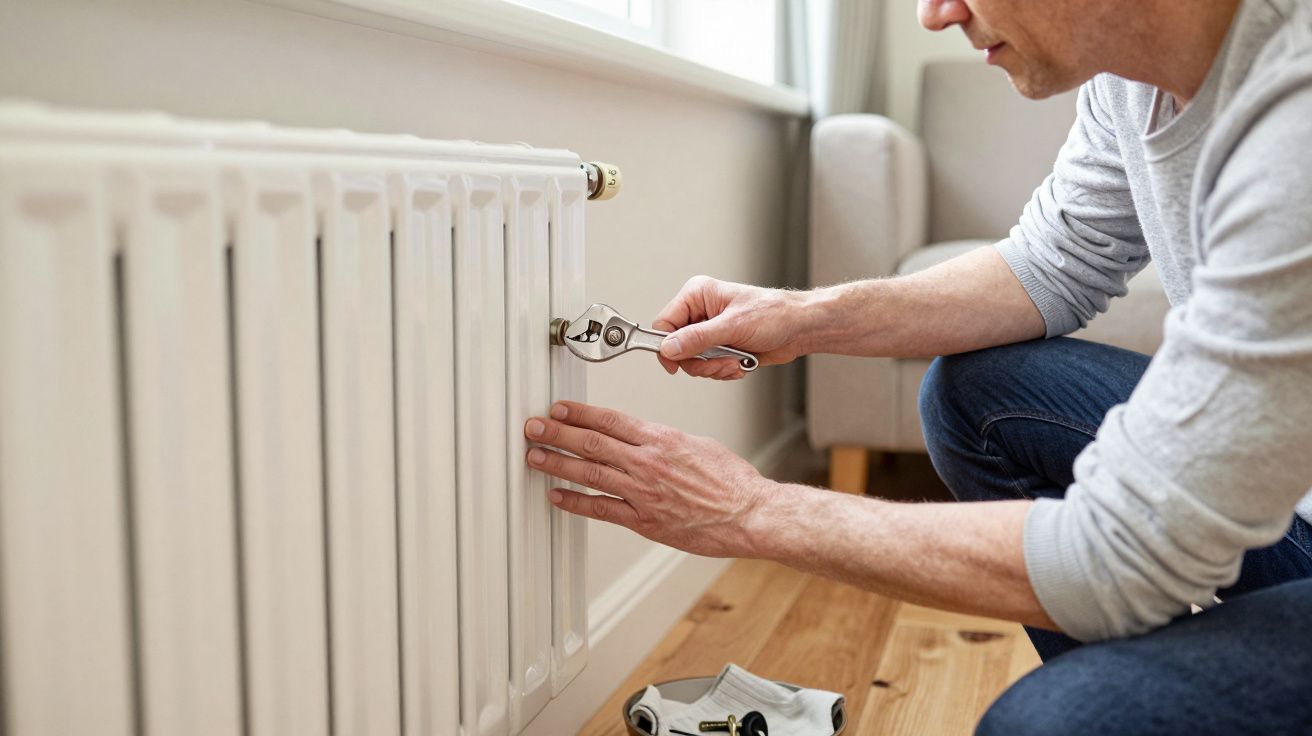
The complaint usually arrives as a shrug: one radiator scalding at the top, cold at the bottom; another that only warms on the side nearest the valve. Radiator balancing is the quiet fix for this, used on UK wet central-heating systems to tame flow imbalance - the tendency for water to rush through the easiest route and starve the rest. It matters because the same boiler can feel “weak” or “temperamental” when the real problem is simply that the heat isn’t being shared fairly.
I first noticed how calmly engineers treat it. They don’t blame the boiler straight away. They watch the pipework like a map, hand hovering near a lockshield, listening for the subtle rush that says the system is doing what water always does: taking the shortcut.
The uneven radiator isn’t being difficult. It’s being predictable.
Hot water leaving your boiler wants the shortest, least resistant path. That’s usually the radiator closest to the boiler or the one on the easiest loop, which ends up stealing flow and warming quickly. The radiators further away get whatever is left: slower, cooler water and a longer wait.
This is why “they all worked fine last winter” can still be true. A small change - a new TRV head, a partly closed valve after decorating, a pump setting tweak, even sludge dislodged during a drain-down - can tilt the balance. The physics didn’t change. The resistances did.
Engineers quietly look for the giveaway pattern: near radiators too hot, far radiators lukewarm, and one or two that never quite catch up. It’s not a mystery fault. It’s a distribution problem.
What radiator balancing really adjusts (and what it doesn’t)
Balancing is not bleeding, though people often do them together. Bleeding deals with trapped air; balancing deals with too much or too little flow through each radiator. It’s also not a magic cure for a system full of sludge, a stuck zone valve, or a pump that’s on its last legs.
What balancing does is simple: it adds a bit of “deliberate difficulty” to the radiators that are hogging the water, using the lockshield valves (the plain caps, not the thermostatic heads). That nudges more flow towards the radiators that are being starved, so the whole system warms more evenly.
When it’s right, you don’t necessarily get hotter radiators. You get a more consistent rise across the house, fewer rooms lagging behind, and a boiler that stops cycling like it’s impatient.
The tells engineers watch before touching a valve
They’ll often do a quick tour before turning anything. Not in a dramatic way - just a sequence of small checks that prevents you “fixing” the wrong thing.
- Top hot, bottom cold: can be air, but can also be low flow through the radiator or heavy sludge at the bottom.
- One side hot, the other cool: often low flow, sometimes a partially shut valve.
- Radiator nearest the boiler roaring hot first: classic sign it’s stealing flow.
- TRVs all wide open but rooms still uneven: suggests distribution, not demand.
- Boiler short-cycling (on/off frequently): can be excess flow through a few rads and not enough system-wide load.
A good engineer also notices the human factor: someone “just nipped that valve down” months ago to stop a room overheating. That tiny tweak can ripple through the whole circuit.
How to balance radiators at home without turning it into a saga
You don’t need lab instruments. You do need patience, because every adjustment takes time to show up around the system.
A calm, workable method
- Start cold: turn heating off and let radiators cool so you’re not chasing moving temperatures.
- Open everything: set all TRVs to max (or fully open) and open all lockshields a couple of turns to establish a baseline.
- Turn heating on: let the system run until radiators start warming consistently.
- Find the fast ones: identify the radiators that heat quickest and hottest (often nearest the boiler).
- Throttle with lockshields: on those fast radiators, close the lockshield gradually (e.g., quarter-turn steps). Wait 10–15 minutes between rounds.
- Aim for “fairness”: the goal is that all radiators warm up at a similar pace, not that every surface is identical.
If you want a more technical target, many engineers work by temperature drop across each radiator (flow pipe vs return pipe). They’re often looking for a modest, consistent drop rather than wild differences from one radiator to the next. You can do this with clip-on pipe thermometers, but you can also get surprisingly far with careful hand checks and time.
Two warnings that save a lot of grief: don’t fully close lockshields (you can trap flow and create noise), and don’t make multiple big changes at once. The system needs time to “declare” what your last tweak did.
Where uneven heat is not a balancing problem
Balancing has a satisfying “click” when it’s the right tool. When it isn’t, you can fiddle for hours and still feel cheated.
Look elsewhere if you have: - A radiator cold at the top and hot at the bottom even after bleeding: rare, but points away from simple air. - Only one radiator not heating while others are fine: could be a stuck valve pin, blockage, or a closed lockshield. - Gurgling, constant refilling, or pressure drops: suggests air ingress, leaks, or expansion vessel issues. - Repeated cold bottoms across many radiators: often sludge; balancing won’t remove the insulating layer.
In those cases, the “engineer quietly watching” bit is them deciding whether you need cleaning, valve work, or a system check rather than another round of tiny lockshield turns.
The small payoff that makes it worth doing
A balanced system feels boring in the best way. Rooms come up together, thermostats behave, and you stop compensating by cranking the boiler temperature or leaving doors open like you’re trying to steer heat with hallway drafts.
It’s also one of the few heating tweaks that costs almost nothing except attention. The trick is accepting what water does, then gently persuading it to share.
- Gear: adjustable spanner, radiator key (for bleeding), cloth, small bowl, marker pen for valve positions.
- Timing: 60–120 minutes for a small house; longer if the system is slow to respond.
- Mindset: tiny adjustments, long pauses, and a willingness to stop when it’s “even enough”.
FAQ:
- Is radiator balancing the same as bleeding? No. Bleeding removes trapped air; balancing adjusts flow so radiators heat more evenly.
- Should I balance with TRVs on or off? Set TRVs fully open while balancing so they don’t interfere, then return them to normal settings afterwards.
- Why does the radiator nearest the boiler get hottest first? Because it usually has the least resistance, so it receives disproportionate flow unless you throttle it with the lockshield.
- Can balancing fix a cold bottom on a radiator? Sometimes, if it’s a flow issue. If multiple radiators have cold bottoms, sludge is more likely and may need flushing or cleaning.
- What if I’ve lost track of where valves were originally? Count turns as you adjust and note them down. If you get lost, you can open lockshields back up and restart from a simple baseline.



Comments (0)
No comments yet. Be the first to comment!
Leave a Comment