
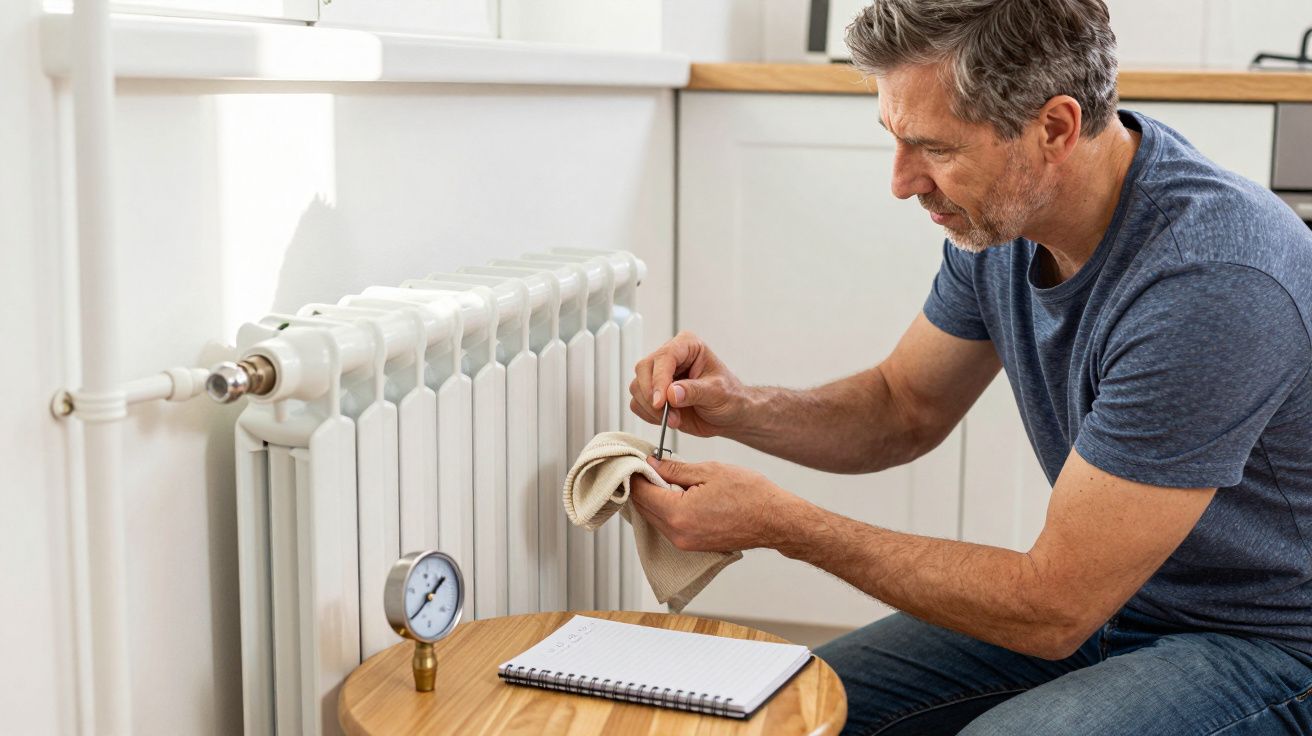
Power flushing is the clean-out service used on wet central heating systems to move water fast through radiators and pipework and carry away the sludge you can’t see. If you’re getting cold spots across a radiator-usually along the bottom-this is one of the few fixes that targets the actual cause rather than the symptoms. It matters because those patches aren’t just “old house quirks”; they’re lost heat you’re paying for, and strain your boiler feels every day.
On a January call-out in a semi in the Midlands, the homeowner had done all the sensible things: bled radiators, checked the thermostat, even turned the pump up a notch. The lounge radiator still warmed at the top and stayed stubbornly cool along the lower edge. The room never quite caught up, and the boiler seemed to run longer than it should.
The radiator problem people misdiagnose
Most “half-cold” radiator complaints get funnelled into two buckets: trapped air or a dodgy valve. Air does happen-radiators can gurgle, the top edge stays cold, and bleeding gets you an immediate improvement. But cold spots that cling to the bottom third, especially if they return quickly after bleeding, usually point elsewhere.
The unglamorous culprit is magnetite sludge: fine black iron oxide created as water, steel radiators, and oxygen do their slow chemistry over years. It settles where flow is slower, which is why the bottom of radiators becomes a storage shelf for the stuff.
Heat isn’t just about temperature; it’s about flow. If water can’t move properly through the panel, the radiator can’t give heat back to the room evenly.
What power flushing actually fixes (and what it doesn’t)
Power flushing works when the underlying issue is restricted circulation caused by sludge, debris, or scale in the radiator and heating circuit. The machine pumps water at high flow rates through each radiator in turn, often with a cleaning chemical, and dislodges the compacted layer that normal system circulation can’t shift.
That’s why it can genuinely improve: - Cold spots at the bottom of radiators (sludge lifting out of the panel). - Radiators that take ages to warm up compared with others (uneven flow across the system). - Noisy boiler or pump caused by poor circulation (not every noise, but many). - Frequent need to bleed when corrosion debris keeps moving around (the “dirty system” pattern).
But it won’t magically fix: - A radiator that’s undersized for the room. - A boiler that’s failing to modulate properly or short-cycling for unrelated reasons. - A stuck thermostatic radiator valve (TRV) pin, or a seized lockshield. - Badly balanced systems where one radiator hogs flow and another starves.
Power flushing is a circulation-and-contamination solution. If the problem is design, controls, or a component fault, you’ll still need targeted work.
Why cold spots form in the first place
Picture the radiator as a shallow riverbed. Hot water wants to enter, spread, and exit smoothly; the metal wants to pass that heat into the room. Sludge changes both.
As magnetite accumulates, it narrows the internal waterways and acts like an insulating layer. The top can still feel hot because the first pass of water is warm and the metal is exposed, while the bottom stays tepid because flow is choked and heat transfer is muffled under a dense deposit.
There’s a secondary problem that follows: once flow is restricted, the boiler works harder to reach target temperatures, and pumps push against resistance. Over time, that can shorten component life-especially pumps, heat exchangers, and diverter valves on combis.
The “it helped, but only because we did the other bits too” reality
A good power flush is rarely just a machine-and-go procedure. The best results come when the engineer treats it like a system reset and finishes the job properly.
Typical steps that make the difference: - Isolate and flush radiators one by one, not just a quick loop around the system. - Use a magnet on the return to see what’s actually coming out (the water tells on you). - Clean the magnetic filter (or fit one if missing) and flush again if it loads up quickly. - Refill with inhibitor at the correct dose, then check system pressure and vents. - Balance radiators afterwards so heat distribution matches the home’s demand.
If you skip inhibitor, sludge comes back. If you skip balancing, some rooms still lag. If you skip the filter, debris has a free run at the boiler.
A simple way to tell if power flushing is the right tool
You don’t need to be a heating engineer to do a basic triage before you book anything. You just need to notice patterns.
Look for this cluster: - Bottom-of-radiator cold spots that persist after bleeding. - Multiple radiators affected, not just one. - Water from a radiator bleed point that looks brown/black rather than clear. - A magnetic filter (if you have one) that clogs quickly or hasn’t been cleaned in ages.
And look for the “not a flush” cluster: - Only the top is cold and bleeding fixes it. - One radiator misbehaves while the rest are fine (often a valve or balancing issue). - The boiler can’t hold temperature, or pressure drops regularly (possible leaks/boiler faults).
What to ask for, so you actually get the outcome you’re paying for
Because “power flush” can mean anything from thorough to cosmetic, it’s worth asking a few direct questions. Not confrontational-just clear.
- Will you flush each radiator individually and agitate as needed?
- Will you dose cleaner, and how will you neutralise/flush it out afterwards?
- Will you fit or service a magnetic filter?
- Will you add inhibitor and confirm the system is protected after the work?
- Will you check and balance the system once flow is restored?
A decent installer won’t flinch at these. They’ll usually be relieved you’re talking about outcomes rather than buzzwords.
The payoff is not just hotter radiators
When cold spots disappear, the obvious win is comfort. The less obvious win is that the system reaches temperature quicker and cycles more predictably, which is where efficiency tends to improve in real homes.
Think of it like clearing a blocked artery rather than turning the thermostat up. You’re not demanding more from the system; you’re letting it do what it was already trying to do.
| Symptom | Likely cause | What helps |
|---|---|---|
| Cold at bottom, warm at top | Sludge/magnetite | Power flushing + inhibitor |
| Cold at top, gurgling | Air | Bleeding + check pressure/venting |
| One radiator cold, others fine | Valve/balancing | TRV/lockshield work |
FAQ:
- Will power flushing definitely remove cold spots? If the cold spots are caused by sludge restricting flow or insulating the panel, it usually makes a noticeable difference. If the cause is a stuck valve, poor balancing, or an undersized radiator, flushing won’t be the fix.
- Can I just add a chemical cleaner instead? Cleaners can help, but without high flow to dislodge and carry debris out, you often end up moving sludge around rather than removing it. A flush is the “remove it from the system” step.
- How long does a power flush take? Commonly a few hours for a typical home, depending on radiator count, how dirty the system is, and whether filters/valves need attention during the job.
- Do I need a magnetic filter after a power flush? It’s strongly recommended. The flush removes what’s there; the filter catches what forms later and what’s left behind, protecting the boiler and keeping radiators clear.
- How do I stop sludge coming back? Add inhibitor at the right dose, keep the system sealed and pressurised correctly, clean the magnetic filter periodically, and address any ongoing source of oxygen ingress (like frequent top-ups).

Comments (0)
No comments yet. Be the first to comment!
Leave a Comment