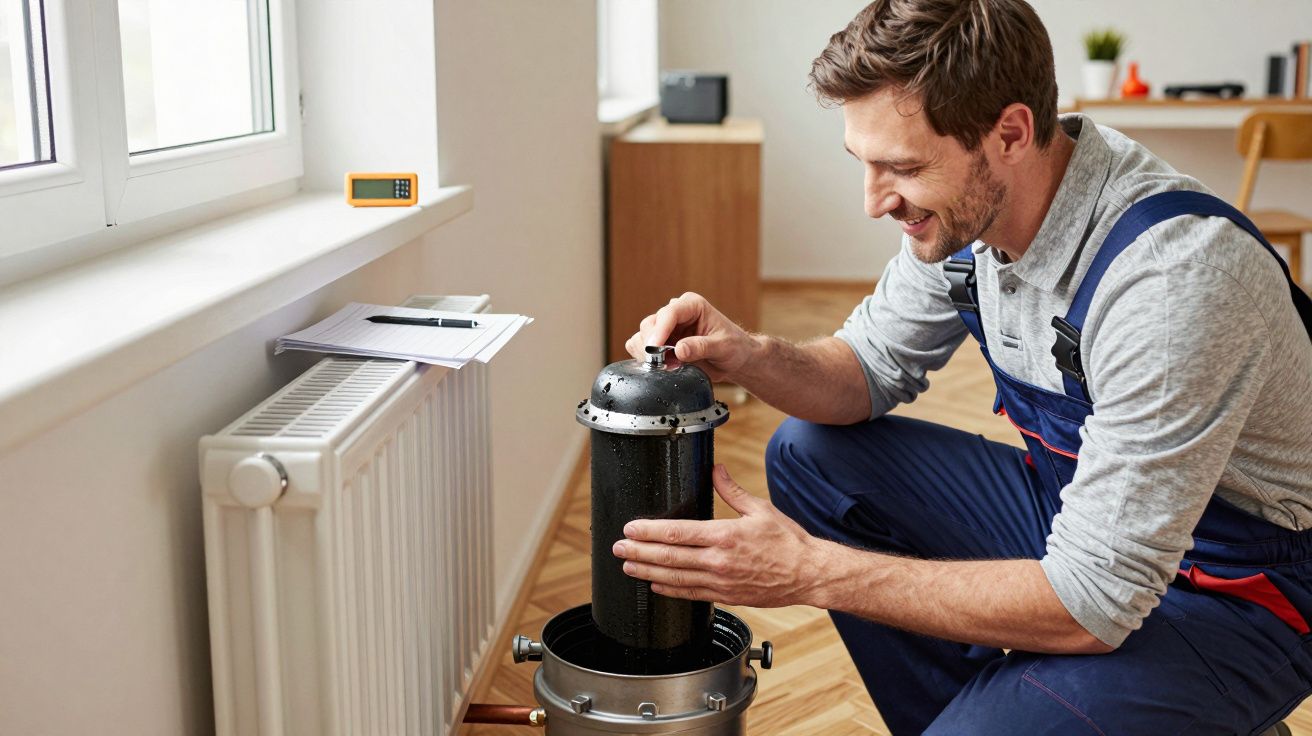
Power flushes come up in the quiet moment after the boiler’s been condemned as “noisy”, the radiator upstairs won’t heat, and somebody mentions sludge like it’s a diagnosis. Power flushing is a high-flow clean of a wet central heating system, used to shift magnetite and debris from radiators and pipework, and the cost versus benefit argument is why two competent engineers can look at the same house and give opposite advice. It matters because a flush can genuinely rescue performance-or it can simply move money from your bank account to your system’s past mistakes.
In most homes, the debate isn’t whether sludge exists. It’s whether the system’s problems are actually caused by sludge, and whether a dramatic intervention beats a targeted fix with better long-term protection.
What engineers mean when they argue about a power flush
A power flush isn’t just “running cleaner through”. A pump is connected to the system (often in place of a circulator or across tails), water is driven at higher velocity than normal, and radiators are agitated while chemicals help lift deposits.
The aim is simple: restore flow, improve heat transfer, and protect new components-especially if you’ve just fitted a boiler, pump, or radiator valves. The problem is that “simple” can hide three different realities: a light clean, a full system recovery, or an expensive attempt to cure a fault that lives elsewhere.
A flush is a tool, not a moral stance. The question is whether it’s the right tool for this fault in this system.
The common faults people label as “needs a flush”
- Cold spots on radiators (especially at the bottom)
- Boiler kettling or rumbling (sometimes)
- Noisy pump, poor circulation, or slow warm-up
- Repeated blockage of filters, valves, or plate heat exchangers
- Radiators heating only with all others off (hydraulic imbalance, sometimes sludge)
Notice the overlap: several of these can be caused by balancing issues, stuck valves, undersized pipework, or control problems. Sludge is often present, but not always the villain.
The hidden split: “dirty water” versus “dirty system”
Engineers tend to split into two camps, and both have a point.
One camp says: if the water’s black, the system is contaminated; a full flush resets the baseline. The other says: dirty water doesn’t automatically justify a full-bore intervention, because you can remove debris gradually and stabilise it with inhibitors and filtration.
In practice, the difference is less about ideology and more about risk tolerance. A flush can expose weak points-pinholes in old radiators, tired valves, joints that were sealed by years of grime. That’s not the flush “breaking the system”; it’s the flush revealing what was already failing. But for the homeowner, the distinction doesn’t soften the invoice.
Cost versus benefit: what you’re really paying for
The bill isn’t just time on site. You’re paying for labour, chemicals, water handling, risk, and-if the engineer is doing it properly-diagnosis before and verification after.
Here’s how engineers quietly run the calculation:
- Best-case benefit: improved heat output, faster warm-up, fewer call-backs, longer life for pumps/valves/boiler components.
- Worst-case outcome: little performance change because the real fault was balancing/controls; plus leaks appear and you’re buying radiators too.
- Opportunity cost: the same money could fund a magnetic filter upgrade, radiator replacements, TRVs, zoning tweaks, and a proper commissioning.
A good quote often sounds cautious because it’s pricing uncertainty. A bad quote sounds confident because it’s selling certainty that doesn’t exist.
A quick way engineers frame the decision
| Situation | Likely value of a flush | Better first step |
|---|---|---|
| New boiler onto old rads with unknown history | High (risk management) | Filter + flush + inhibitor |
| One radiator cold, others fine | Low to medium | Valve check, balance, local clean |
| Repeated blockages / HX issues | High | Flush + filtration strategy |
When a power flush is genuinely the sensible call
Some systems are telling you, plainly, that debris is travelling and causing harm. If a plate heat exchanger keeps clogging, or you’re finding gritty deposits in valves and filters, a half-measure can become the expensive option.
It’s also defensible when you’re doing major work. Fitting a new boiler to a neglected system without cleaning and protection is like putting fresh oil into an engine full of metal swarf. You might get away with it. You might not.
Green flags that the system will likely respond well
- Multiple radiators show bottom-up cold areas and improve temporarily after bleeding/pressure tweaks
- Filter (if fitted) is collecting significant sludge repeatedly
- Flow rate has clearly fallen over time with no control changes
- The engineer can demonstrate poor delta-T/heat-up behaviour and then re-test post-clean
When engineers push back (and why they’re not being awkward)
A lot of “needs a power flush” diagnoses are shorthand for “the system hasn’t been maintained”. But the clean doesn’t replace good design and commissioning.
If the underlying issue is balancing, a flush can leave you with beautifully clean water… still taking the easiest path through the nearest radiators. If the issue is a stuck lockshield, a partially closed service valve, or a bypass mis-set, the expensive clean is theatre.
There’s also the materials question. Older microbore systems, mixed metals, and tired radiators can respond unpredictably. Some engineers would rather do staged cleaning and component replacement than stir everything at once.
The part homeowners rarely hear: what “done properly” looks like
The argument often isn’t “flush or no flush”. It’s “flush badly” versus “flush as part of a plan”.
A decent process usually includes:
- Isolating and cleaning radiators one-by-one where needed (not just swirling the system and hoping)
- Using the right chemical for the deposit type and dwell time
- Checking pump performance, bypass settings, and system balance after cleaning
- Installing a magnetic filter (or servicing the existing one)
- Dosing inhibitor correctly and recording what was added
- Verifying improvement: heat-up time, temperature drop across rads, stable pressures
If none of that is mentioned, you’re not being sold cleaning-you’re being sold a ritual.
A calmer way to settle the debate in your own house
Ask for evidence, not a speech. The best engineers can show you what they’re seeing and explain why it points to a flush or away from one.
Try these prompts:
- “What fault are you treating, specifically?”
- “What will you measure before and after to prove it worked?”
- “If the flush doesn’t improve it, what’s next?”
- “What protection are we adding so it doesn’t reoccur?”
You’re not trying to catch anyone out. You’re trying to make sure the cost versus benefit decision is based on your system’s behaviour, not on habit.
FAQ:
- Will a power flush definitely make my heating cheaper to run? Sometimes, but not reliably. It can improve heat transfer and circulation, which may reduce boiler cycling and warm-up time, but controls, insulation, and balancing often make a bigger difference.
- Can a power flush cause leaks? It can reveal existing weak spots (especially old radiators and valves). A careful engineer will flag that risk upfront and discuss contingencies.
- Do I need one when fitting a new boiler? Often recommended if the system is older or contaminated, but the real requirement is effective cleaning plus proper filtration and inhibitor. Ask what standard the installer is working to and what evidence they’ll provide.
- Is a chemical flush the same thing? No. A chemical flush can be gentler and slower, sometimes done over days/weeks with normal circulation. A power flush is higher-flow, more intensive, and more disruptive.






Comments (0)
No comments yet. Be the first to comment!
Leave a Comment