Most emergency repairs don’t start with a bang. They start with early signs of failure that look harmless in the moment: a faint drip, a new rattle, a slight dip in pressure. In homes, offices, and rented flats, that “it can wait” cue is often what turns a simple fix into an urgent call-out.
The warning sign people ignore most is moisture where it shouldn’t be-especially small leaks and repeated damp patches. Water rarely stays put. It tracks along joists, behind cabinets, under flooring, and into electrics, compounding damage quietly until something finally gives.
A drip is not a drip. It’s a timer.
Why a tiny leak becomes a big emergency
A slow leak feels manageable because it doesn’t interrupt your day. But it steadily loads your home with risk: swelling timber, weakened plaster, mould growth, corrosion on fittings, and sometimes a sudden burst when pressure shifts.
Moisture also hides the true fault. A stained ceiling might be a worn washer, a failing valve, or a pinhole in pipework-each fixable early, all expensive when left long enough to saturate surrounding materials.
The “delay spiral” that drives call-outs
- You notice a patch, wipe it, and forget it.
- The damp returns, slightly larger, slightly softer underfoot.
- A fitting gives way under pressure (overnight is common).
- You end up shutting off the mains, hunting for a stopcock, and calling for emergency help.
It’s not bad luck. It’s cumulative damage finally becoming visible.
The early warning signs to take seriously (before they cost you)
Look for patterns, not drama. Emergencies often follow small, repeated cues that people normalise.
Plumbing and heating
- Drips under the kitchen sink or at the back of the loo
- “Kettling” or banging from a boiler, especially on heat-up
- Radiators needing frequent bleeding or topping up pressure
- Hot water that runs warm–cold–warm, or takes longer than usual
A boiler that’s repeatedly losing pressure is not being “temperamental”. It’s telling you water is escaping somewhere, or a component is failing.
Electrics (often moisture-related)
- A socket or light that crackles, flickers, or feels warm
- A faint burning smell near switches, especially after showers or cooking
- Trip switches that start going “randomly”
If moisture is involved, stop using the circuit and get it checked. Water and electricity don’t negotiate.
Structure and surfaces
- Paint bubbling, flaking, or a “tide mark” on walls/ceilings
- Floorboards that feel springy, tiles that loosen, or laminate lifting at edges
- Musty odour that returns after airing the room
That smell is often damp trapped behind something-not a “stale room”.
A 10-minute weekly check that prevents most call-outs
Borrow the logic of a short, repeatable routine: small effort, consistent timing, fewer surprises. Pick one day and do the same circuit each week so changes stand out.
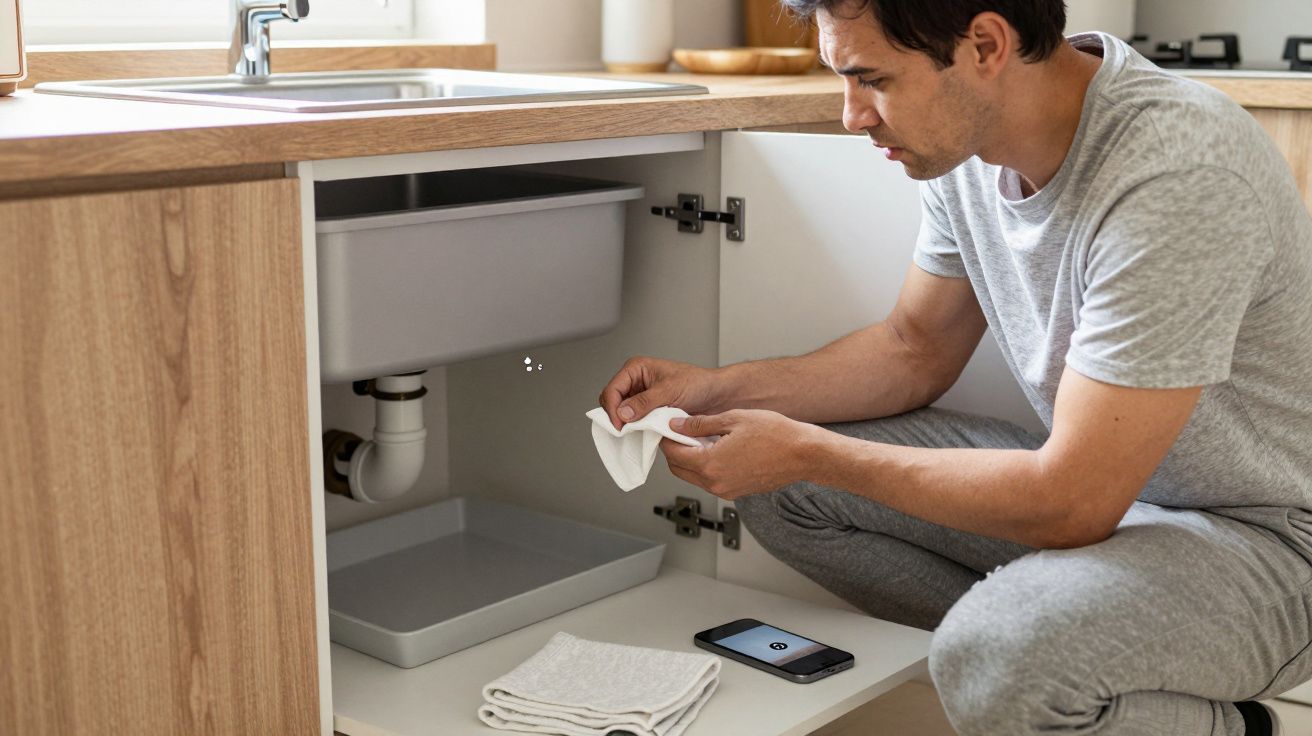
- Under-sink sweep (kitchen + bathroom): run a dry tissue around trap joints and valves; look for green/white crusting on copper.
- Toilet base and cistern: check for wobble, damp at the base, and any trickle sound after flushing.
- Boiler glance: note pressure reading and any new noise; check the area beneath for staining.
- External wall/loft quick look (if accessible): scan for fresh marks after rain.
Keep it boring on purpose. Emergencies thrive on forgotten corners.
Two minutes with a tissue beats two hours with buckets.
If you spot moisture: what to do immediately
Don’t jump straight to ripping things out. Do a calm, practical first response that limits damage and gives a professional useful clues.
- Contain: place a tray/towel, keep water away from electrics, and clear cupboards.
- Confirm: dry the area, then check again in 30–60 minutes to see if it returns.
- Shut off (if needed): know where your stopcock is; if the leak is active, turn water off and open a cold tap to relieve pressure.
- Document: take a quick photo and note when it appears (after showering, after heating turns on, during rain).
If you’re in a rental, report it early. Many tenancy disputes come down to “known damp left to worsen”.
The parts that fail quietly (and how they warn you)
Most home systems don’t fail without signalling. The signals are just subtle.
Flexible hoses and isolation valves
Washing machine and dishwasher hoses often fail at the ends, not in the middle. You may see a slight crust, a faint damp ring, or occasional droplets that appear after the appliance runs.
Isolation valves can seep only when moved. If you’ve recently turned one, check it the next day.
Silicone, grout, and seals
Bathroom seals don’t merely “look tired”. When silicone peels or grout cracks, water gets behind tiles and into plasterboard. The first clue is often a musty smell or a soft skirting board, not an obvious puddle.
Boiler pressure loss
A small, repeated drop in pressure is an early sign of failure that people ignore because the boiler still works. It might be a leak on a valve, a faulty expansion vessel, or corrosion beginning in the system. Left alone, it can turn into a breakdown on the coldest night.
When it’s urgent (and when it can wait)
Use a simple threshold: active water + unknown source = act now. If water is moving and you can’t confidently stop it, it’s an emergency.
If it’s a stable stain with no dampness and no change over a week, it’s usually not an immediate call-out-but it still needs investigation. “Not urgent” doesn’t mean “not important”.
| Sign | Likely level | First move |
|---|---|---|
| Water dripping, pooling, or hissing | Emergency | Shut off supply, protect electrics, call |
| Boiler losing pressure repeatedly | Soon | Book a service; check for visible leaks |
| Old stain, dry and unchanged | Monitor | Mark edges, recheck after rain/use |
The detail that changes outcomes
People wait for a dramatic failure, but the decisive moment is earlier: the first time you see moisture return after drying it. That repeat is the system telling you it’s not a one-off splash-it’s a fault.
Treat repeated damp as a maintenance task, not an inconvenience. You’ll spend less, disrupt less, and avoid the call-out that always seems to happen at the worst possible time.





Comments (0)
No comments yet. Be the first to comment!
Leave a Comment