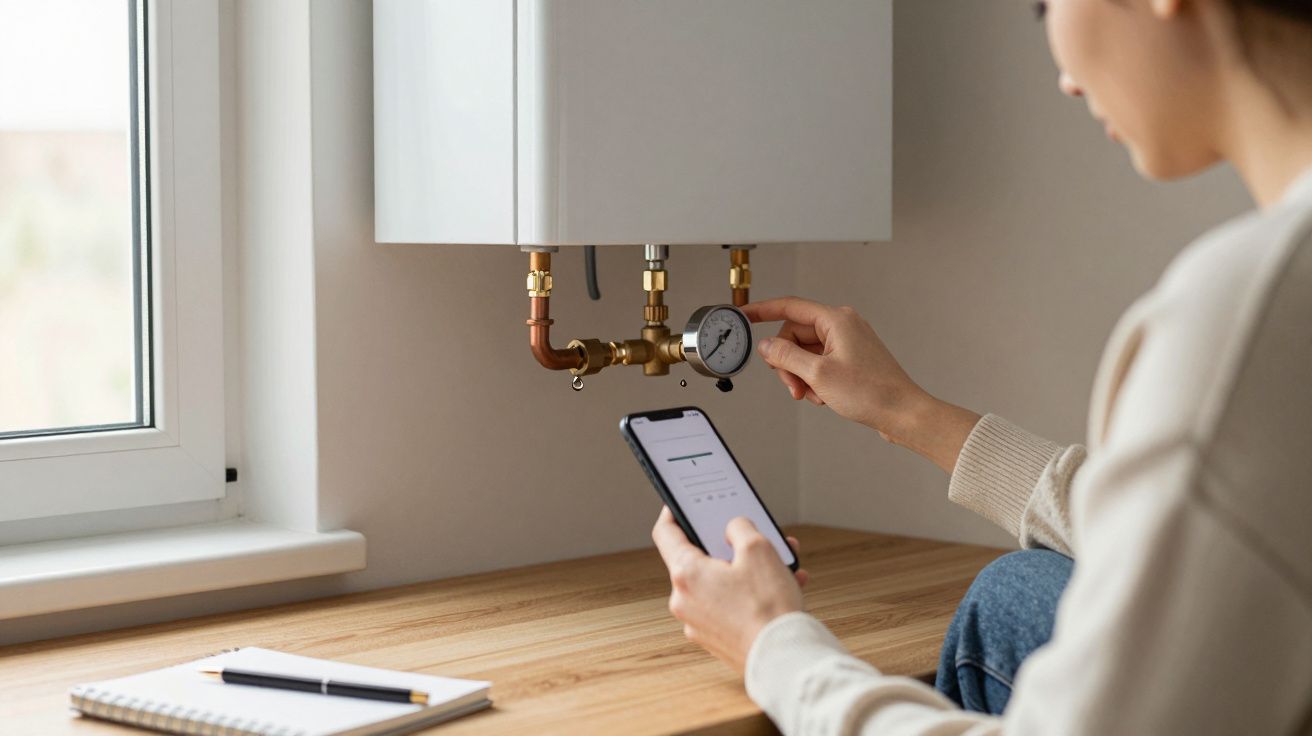
The first sign isn’t dramatic. System stability in a home plumbing-heating setup often starts to slip when expansion pressure is left to wander, quietly, week after week. It matters because the system can keep “working” while stress builds in the wrong places-until a valve weeps, a boiler locks out, or radiators start sounding like a kettle.
You might notice it on a cold Tuesday: a faint drip from the discharge pipe outside, a pressure gauge that’s never quite where you left it, a top-up you’re doing more often than you admit. None of it feels urgent. That’s exactly how the slow destabilisation wins.
The ignored fault that looks like nothing
Most people meet it as an inconvenience: the boiler pressure drops, so you top it up. Or the pressure rises when the heating is on, so you “just keep an eye on it”. The problem is that sealed systems aren’t supposed to need babysitting. If you’re interacting with the pressure regularly, the system is trying to tell you something.
In many homes the “one fault” is a tired expansion vessel (or its air charge), sometimes paired with a sticky filling loop, and occasionally masked by a pressure relief valve (PRV) that’s started to pass. On paper these are small parts. In practice they’re the parts that govern how calm the whole system stays when water heats, expands, and has to go somewhere.
A sealed heating circuit is like a closed jar. Heat the contents and pressure rises. If the cushion-the expansion capacity-is gone, pressure doesn’t rise gently. It spikes.
What expansion pressure is actually doing in your house
When cold, a typical combi or sealed system might sit around 1.0–1.5 bar. When hot, it should climb a bit and settle, not leap like it’s been startled. That controlled rise is the expansion vessel’s job: it gives expanding water somewhere to push without forcing the rest of the system to take the hit.
When that vessel loses its charge (or its diaphragm fails), the “somewhere to push” disappears. The system starts behaving like it has mood swings:
- Cold pressure seems fine after topping up.
- Hot pressure shoots towards 2.5–3.0 bar.
- The PRV opens briefly to protect the boiler.
- Once it cools, pressure has dropped again-because you’ve lost water.
That cycle can repeat for months, because each individual event is small. The damage comes from repetition.
The slow cascade: how stability is lost, bit by bit
A sealed system doesn’t usually fail from one heroic break. It fails from tiny compromises stacking up until the whole thing becomes unpredictable.
Here’s the common chain reaction:
- Expansion vessel undercharged/failed → pressure swings become extreme.
- PRV lifts to protect the boiler → a little water discharges outside.
- PRV seat no longer seals perfectly → it starts passing even at normal pressures.
- You top up more often → fresh oxygenated water enters repeatedly.
- Corrosion and sludge accelerate → pumps, heat exchangers, and valves get dirtier.
- System stability degrades → more noise, uneven heating, more faults, more top-ups.
The nasty bit is the oxygen. Every top-up brings in dissolved air, and air is a quiet ingredient in rust. The system becomes a slow chemistry experiment you didn’t mean to run.
The “looks fine” symptoms that should make you pause
People wait for a dramatic error code. But the system often whispers first, and it whispers in patterns:
- The pressure gauge climbs sharply when the heating comes on, then falls low when off.
- The external copper discharge pipe drips after a heating cycle (not just on very cold mornings).
- Radiators need bleeding often, and the same ones keep collecting air.
- Hot water is fine, but heating cycles feel “rough”: banging, ticking, kettling.
- You’re topping up monthly (or weekly) and telling yourself it’s normal.
One of the most misleading moments is when topping up “fixes” it. It doesn’t fix it. It resets the clock.
A quick mental model: the system as a safety rail, not a performance feature
People treat pressure like performance: more bar, more heat. In sealed heating it’s more like a safety rail. Enough pressure keeps circulation stable and prevents air ingress. Too much pressure forces safety devices to intervene. Too little pressure invites air, cavitation, and poor flow.
Think of it the way hospitals use checklists: not because they don’t know medicine, but because the small basics prevent cascades. With heating, the basics are boring-until they aren’t.
What “normal” often looks like (rule of thumb)
| System state | Typical pressure behaviour | What it suggests |
|---|---|---|
| Cold, idle | Steady around 1.0–1.5 bar | Baseline OK |
| Hot, running | Rises modestly (e.g., +0.3 to +0.8 bar) | Expansion control OK |
| Hot, running | Shoots high, near PRV lift | Expansion vessel/charge issue likely |
Figures vary by property height and design, but the shape of the behaviour matters: gentle rise versus spike-and-drop.
What to do before you keep “just topping up”
If you want stability back, you have to stop treating the symptom as the problem.
- Note cold pressure and hot pressure across a full heating cycle. Write it down once; guessing is how this drags on.
- Check the discharge pipe outside after the heating has been on. Any regular drip is a clue.
- Don’t ignore repeated top-ups. If you’re adding water often, you’re also adding oxygen often.
- Get the expansion vessel tested and recharged (or replaced if the diaphragm has failed). This is usually quick for a professional and changes the whole system’s behaviour.
- If the PRV has lifted repeatedly, consider replacement. Once a PRV has debris on its seat, it can become a “permanent micro-leak”.
- After the pressure issue is fixed, assess sludge protection. Inhibitor levels and filtration matter more once the system has been stressed for a while.
If you only do one thing, do the expansion side properly. It’s the part that turns pressure from a bouncing ball into a steady line.
Why this one repair often makes everything else feel quieter
When expansion is controlled, pumps stop fighting turbulence, air stops appearing as often, and the boiler stops cycling through protective behaviours. Radiators heat more evenly because flow becomes more predictable. Even if you still have other issues-balancing, a tired pump, a sticky diverter-the whole system becomes less brittle.
System stability isn’t glamorous. It’s what lets your heating disappear into the background, which is what you wanted in the first place.
FAQ:
- Is it ever normal to top up a sealed heating system? Very occasionally, after maintenance. Regular top-ups suggest a leak, a passing PRV, or an expansion vessel issue.
- Does high pressure always mean the filling loop is open? Not always. High pressure that appears mainly when heating runs often points to expansion control. A filling loop left open usually raises pressure regardless of temperature.
- If the discharge pipe drips, is the boiler definitely unsafe? It’s a warning sign, not a verdict. But it does mean a safety device is activating or failing to reseal, and it should be investigated promptly.
- Can an expansion vessel be recharged, or must it be replaced? It depends. If the diaphragm is intact, it can often be recharged. If water comes out of the air valve, the diaphragm has likely failed and replacement is typical.




Comments (0)
No comments yet. Be the first to comment!
Leave a Comment