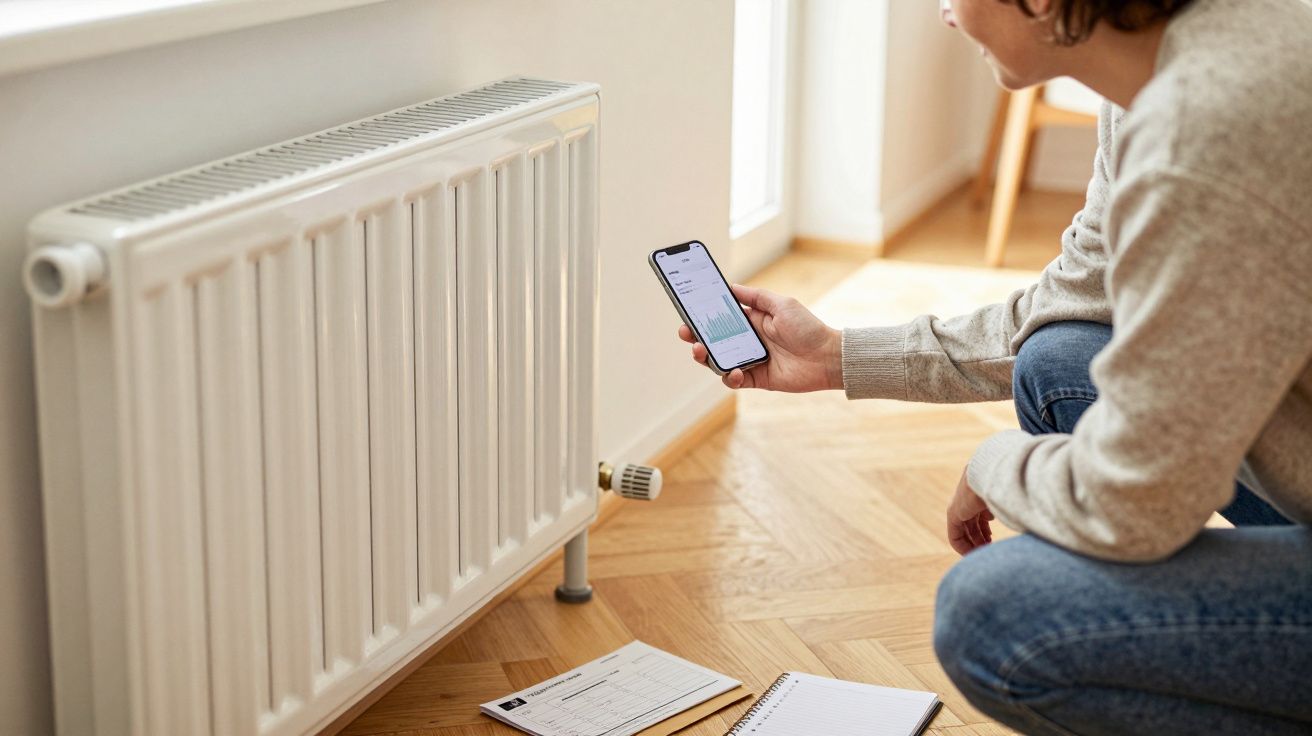
The radiators are hot, the house feels fine, and yet the direct debit keeps creeping up. That’s where heating performance becomes more than a vague “it seems warm enough” feeling - it’s the measure of how much energy your home needs to stay comfortable, and whether that energy is doing useful work. Hidden inefficiency is the quiet gap between those two: the heat you paid for that never really reached you, or reached you in the least effective way.
It usually shows up in ordinary moments. The bedroom that’s always a bit cooler than it should be. The boiler that runs in short, frantic bursts. The thermostat reading 20°C while your feet still feel like they’re on a station platform.
Engineers notice this stuff in the same way a mechanic hears an engine misfire. Not because anything is “broken”, but because the system is telling you it’s working harder than it needs to.
Warm rooms, cold numbers
Most households judge heating by one question: Are we warm? If the answer is yes, we assume the system is doing its job. The bill arriving later feels like a separate problem, something to blame on tariffs, global markets, or “just how it is now”.
But comfort can be a misleading success metric. You can be warm in an inefficient home for the same reason you can fill a leaky bath: you keep pouring more in. Heat pumps, boilers, radiators, underfloor loops - they’ll often brute-force their way to your setpoint, even when the route is messy.
That’s why heating performance matters: it links comfort to cost. It asks whether your home is warm because the system is smart, or warm because you’re paying for losses you can’t see.
The hidden inefficiency engineers look for first
A heating system isn’t one thing. It’s a chain: heat source, controls, distribution, emitters, and the building itself. Hidden inefficiency creeps in at the joins, where each part is “fine” on its own but the combination is quietly expensive.
Common culprits tend to look boring:
- Overshooting and cycling: the boiler or heat pump fires up, shuts down, fires up again. Lots of starts, not much steady output.
- Flow temperature too high: water leaving the heat source is hotter than it needs to be, which can crush efficiency (especially with heat pumps).
- Unbalanced radiators: one room gets a sauna, another gets a shrug. People then turn up the whole system.
- Heat leaking before it arrives: poorly insulated pipework in voids, garages, or under floors.
- Controls that fight the house: thermostats in the wrong place, TRVs set inconsistently, schedules that heat when no one’s home.
None of these necessarily stops your home reaching 20°C. They just make it cost more to get there.
The “it works” trap
The most expensive phrase in domestic heating is: “It works, doesn’t it?” Because “working” often means the system can still hit temperature under pressure.
On mild days, hidden inefficiency is harder to spot. In cold snaps, it becomes obvious - except most people interpret that moment as the weather being worse, not the system struggling. So they compensate: longer schedules, higher thermostat, portable heaters “just in that room”.
Those little compensations are rational in the moment. Over a winter, they’re a second heating system made of habits.
A quick reality check you can do this week
You don’t need specialist kit to catch the big patterns. You need a couple of observations, written down like you mean it.
- Pick a stable day (similar outdoor temperature, no big cooking or open-window events).
- Set a sensible target (say 19–20°C) and leave it there.
- Listen for cycling: if your boiler repeatedly fires for a few minutes at a time, that’s a hint.
- Walk the house: note rooms that heat fast vs never quite get there.
- Check the “lag”: if the house cools quickly after heating stops, that’s building-side loss.
If the system constantly has to sprint, it’s rarely because you “need more heat”. It’s often because you need less waste.
“When people say the heating is fine, they usually mean the living room is fine. The system may be paying a tax everywhere else.” - building services engineer, retrofit lead
Small fixes that tend to pay back first
There’s a reason professionals start with the dull jobs. They’re the ones that improve heating performance without changing your whole setup.
- Balance radiators so heat is distributed evenly, then lower the overall demand.
- Reduce flow temperature (carefully) and see if comfort stays stable; many systems are set hotter than necessary.
- Insulate accessible pipework in cold zones.
- Move or rethink the thermostat if it sits in a hallway draught or near a radiator.
- Align schedules with occupancy, not with wishful thinking. Heating an empty home is the purest form of hidden inefficiency.
If you’re on a heat pump, the “turn it up for an hour” mindset can be particularly expensive. These systems like steady, low-temperature running. Treating them like a gas boiler often looks fine in comfort terms and dreadful in electricity terms.
Why bills rise even when nothing changed
Part of it is obviously prices. But even when unit rates stay put, systems drift.
Valves stick slightly. Air gets into radiators. A controller gets reset during a power cut. Someone swaps a TRV setting and forgets. A small draught becomes a bigger one after a loft hatch is left ill-fitting. The home’s heating story changes in tiny edits, not dramatic chapters.
And because the house still feels warm, no one goes looking. Engineers do, because they’re trained to distrust “it seems fine” when the data says otherwise.
| What you notice | What it often points to | Why it costs |
|---|---|---|
| Warm upstairs, chilly downstairs | Distribution imbalance, thermostat placement | You overheat one zone to fix another |
| Boiler on/off in short bursts | Oversizing, control settings, poor modulation | Start-stop losses and poorer efficiency |
| Heat pump “works” but bills sting | High flow temps, setbacks, wrong schedule | Lower COP, more kWh for same comfort |
The quiet takeaway
You don’t have to live in a cold house to have a heating problem. You can have a comfortable home with poor heating performance, funded by hidden inefficiency you’ve normalised one winter at a time.
If your bills are rising and nothing else in your life has changed, assume the system is telling you something. It’s rarely shouting. It’s usually just running a bit too hard, for a bit too long, where you can’t see it.
FAQ:
- Isn’t this just energy prices? Prices are real, but inefficiency decides how many units you buy. Two homes can feel equally warm and use very different amounts of energy.
- What’s the quickest sign my system is inefficient? Short cycling (lots of brief on/off runs) and uneven room temperatures are common early clues.
- Do I need to replace my boiler or get a heat pump? Not necessarily. Balancing, control tweaks, and reducing flow temperature can improve performance before any big upgrade.
- Will turning the thermostat down always save money? Often, yes - but the bigger win is making the system deliver the same comfort at a lower flow temperature and with better distribution.
- Can hidden inefficiency be in the building, not the heating? Absolutely. Poor insulation, draughts, and uncontrolled ventilation can force the heating to “work” harder to maintain comfort.






Comments (0)
No comments yet. Be the first to comment!
Leave a Comment