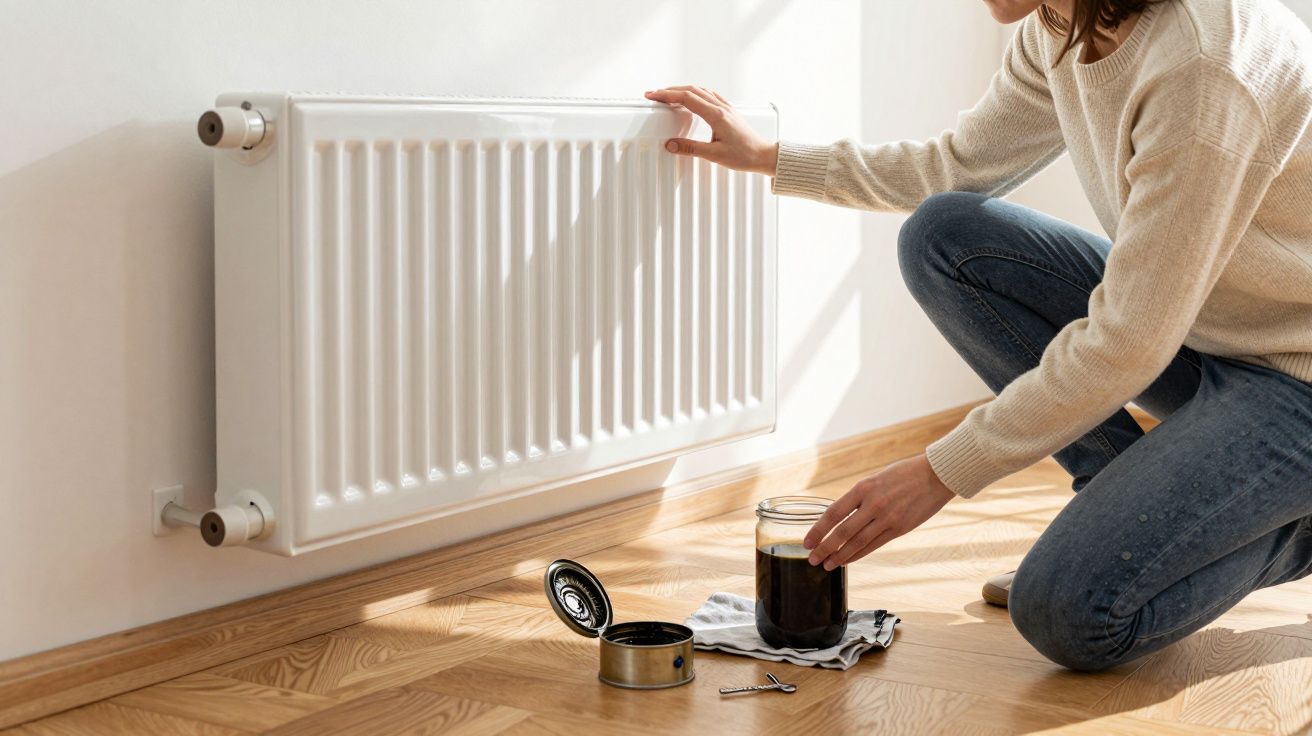
You notice it on the first properly cold morning: the boiler’s humming, the pipes feel lukewarm, but the radiator stays stubbornly chilly at the bottom. Radiator sludge is the quiet culprit in many UK central-heating systems, and power flushing is the deep-clean that shifts it when it’s really built up - which matters because “cold radiator” symptoms often look like boiler trouble when they’re not. Before you brace for a big call-out, it’s worth understanding what your radiators are trying to tell you.
It’s a familiar little domestic panic. You turn the thermostat up, you bleed the radiator “just in case”, you stand there waiting for the heat to catch up. Then you start thinking the expensive thought: the boiler’s gone.
The cold-radiator problem isn’t always at the boiler
Boilers fail, of course. But a boiler can be working perfectly while the heat simply isn’t moving around your home properly. Central heating is a loop: the boiler heats water, the pump pushes it, valves steer it, and radiators dump the heat into rooms.
If that loop is narrowed, blocked, unbalanced or full of trapped air, you can get cold spots, slow warm-up, or whole radiators that never really join in. The boiler gets blamed because it’s the noisy box, but the bottleneck is often somewhere quieter.
Here’s the key tell: if some radiators heat up normally while others don’t, your boiler is less likely to be the main problem. You’re usually looking at circulation, not generation.
Meet the real suspect: what radiator sludge does
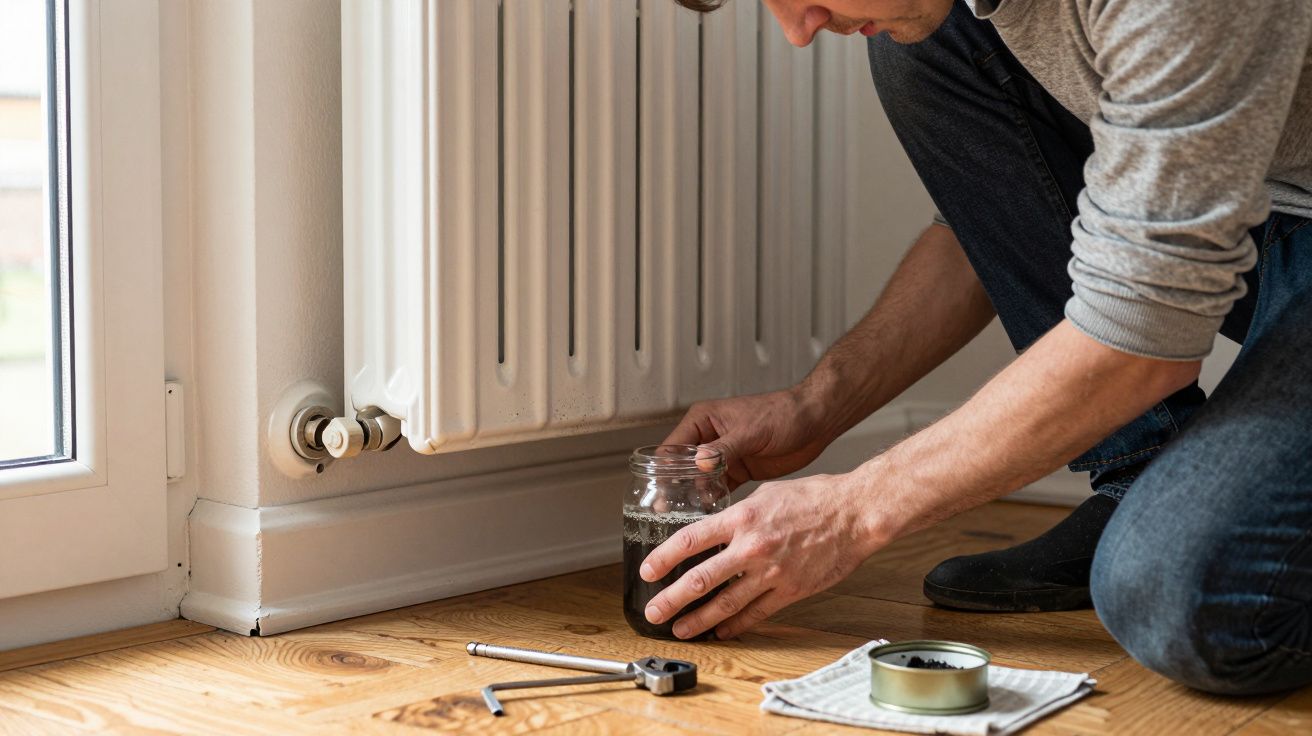
Radiator sludge is a mix of rust (from corrosion inside radiators), limescale, and magnetite - a black, ink-like iron oxide that forms in sealed heating systems. It settles in the lowest, slowest parts of the system, and radiators are basically designed to be exactly that.
Once sludge builds, it doesn’t just “make things a bit less efficient”. It can:
- Block the bottom channels of a radiator, so the top gets warm but the base stays cold
- Reduce flow through the whole system, making far rooms slow to heat
- Make the pump work harder and noisier
- Clog filters and stick thermostatic radiator valves (TRVs)
- Create hot-and-cold swings that feel like the heating has a mind of its own
We’ve all had that moment where a radiator is hot at the top and freezing at the bottom, and you think “air”. Air is common - but sludge often copies the same symptom. Bleeding can feel productive, while the real blockage sits quietly below the waterline.
A quick reality check: what the symptoms usually mean
Before you do anything dramatic, match the pattern to the likely cause. Not perfectly - just enough to avoid guessing.
- Cold at the bottom, warm at the top: often sludge restricting flow inside the radiator
- Cold at the top, warm-ish at the bottom: more often trapped air (bleeding helps)
- One radiator cold, pipes to it hot: stuck TRV pin or a local blockage
- Radiators nearest the boiler hot, far ones cool: balancing issue or weak circulation
- Boiler firing on/off rapidly, house still cool: control settings, flow issues, or system restriction
- Gurgling/knocking: air, low pressure, or sludge moving around
None of this replaces a professional diagnosis. It just stops the “boiler must be dead” spiral when the evidence says otherwise.
What you can check without turning it into a project
Start small and reversible. You’re looking for simple wins and clear signals.
- Check boiler pressure (combi systems often like ~1–1.5 bar when cold). Low pressure can reduce circulation.
- Bleed only the radiators that need it, then recheck pressure. If you bleed a lot, you may need to top up.
- Test TRVs and lockshield valves. A stuck TRV pin is common after summer; it can keep a radiator cold even when everything else is fine.
- Feel the pipes, not just the panel. Hot flow pipe + cool radiator body points to a restriction at the valve or in the radiator.
- Look for system protection. If you’ve got a magnetic filter, check whether it’s full (or when it was last cleaned).
Let’s be honest: most of us do two of these, then decide the universe is against us. But even those two can tell you whether you’re dealing with air/valves or deeper muck.
“Cold radiators are usually a circulation story, not a boiler story. Follow the heat - it shows you where the system is getting stuck.”
When power flushing is the right move (and when it isn’t)
Power flushing is a professional clean where a pump forces water (often with cleaning chemicals) through the system at high velocity, dislodging and removing sludge. Done well, it can transform heat-up time, stop cold spots, and reduce strain on pumps and heat exchangers.
It tends to be worth considering when:
- Several radiators have persistent cold bottoms
- You’ve replaced radiators/boiler parts and problems keep returning
- The system water is consistently dirty (engine-oil black when drained)
- You’re fitting a new boiler and want to protect it from old debris
- There’s a history of noisy pumps, blocked filters, or stuck valves
But it’s not a magic spell for every heating issue. If the problem is simple balancing, a stuck valve, a control setting, or an undersized pump, flushing won’t fix the underlying cause. A good engineer will talk you through evidence first - what they’re seeing in filters, drained water, flow rates - not just sell the most dramatic-sounding option.
The “quiet prevention” that stops sludge coming back
Even after cleaning, systems need protecting. Sludge is a process, not an event.
- Add inhibitor after any drain-down or major work (it slows corrosion)
- Fit/maintain a magnetic filter and clean it routinely
- Fix small leaks - topping up introduces fresh oxygenated water, which drives corrosion
- Balance radiators so flow isn’t starving the end of the circuit
- Service the boiler so pumps, diverter valves and heat exchangers aren’t fighting avoidable restrictions
The goal isn’t perfection. It’s keeping the system water calm, clean, and chemically protected so your radiators stay boring - hot when asked, silent the rest of the time.
| What you notice | Likely cause | What to do next |
|---|---|---|
| Radiator cold at the bottom | Radiator sludge | Assess system water/filter; consider power flush |
| One radiator stays cold | Stuck TRV pin / local restriction | Free the pin; check valves and pipe temps |
| Far rooms heat slowly | Balancing / circulation limits | Balance radiators; check pump/flow settings |
FAQ:
- Is a cold radiator always a sign the boiler is broken? No. If other radiators heat normally, the boiler is often fine and the issue is circulation, valves, air, or sludge.
- Will bleeding fix a radiator that’s cold at the bottom? Sometimes, but not reliably. Cold bottoms are commonly caused by sludge restricting flow inside the radiator, which bleeding won’t remove.
- How do I know if radiator sludge is in my system? Persistent cold spots (especially at the bottom), dirty black water when draining/bleeding, repeated valve/filter blockages, and noisy circulation can all point to sludge.
- Is power flushing safe for older systems? It can be, but it depends on condition. A competent engineer should assess radiator and pipework health, explain risks, and recommend alternatives if flushing could expose weak points.
- What’s the simplest way to prevent sludge after a clean? Keep inhibitor levels correct, clean the magnetic filter, and avoid frequent topping up by fixing leaks quickly.





Comments (0)
No comments yet. Be the first to comment!
Leave a Comment